How a Stranger in a Kochi Hotel Sent a 27-Year-Old to a Country He’d Never Heard Of
One evening in 1976, in the lobby of a small hotel in Kochi, two men sat down for a conversation. One was a Captain in the Sultanate of Oman’s army, in town on personal business. The other was a 27-year-old college dropout with a small interior decoration outfit and a mother and four siblings he was responsible for feeding.
The Captain told the young man there were opportunities in his country for skilled craftsmen. He suggested he come and see for himself.
The young man’s first question, in his own words years later: “Where is the Sultanate of Oman?”
He had never heard of the place. He owned almost nothing. He had every reason to politely thank the Captain, finish his tea, and go home. About 45 days later, he got on a flight to Muscat with Rs 50 in his pocket, around 7 US dollars at the 1976 exchange rate, and the name of a partner who would loan him the money to start a business.
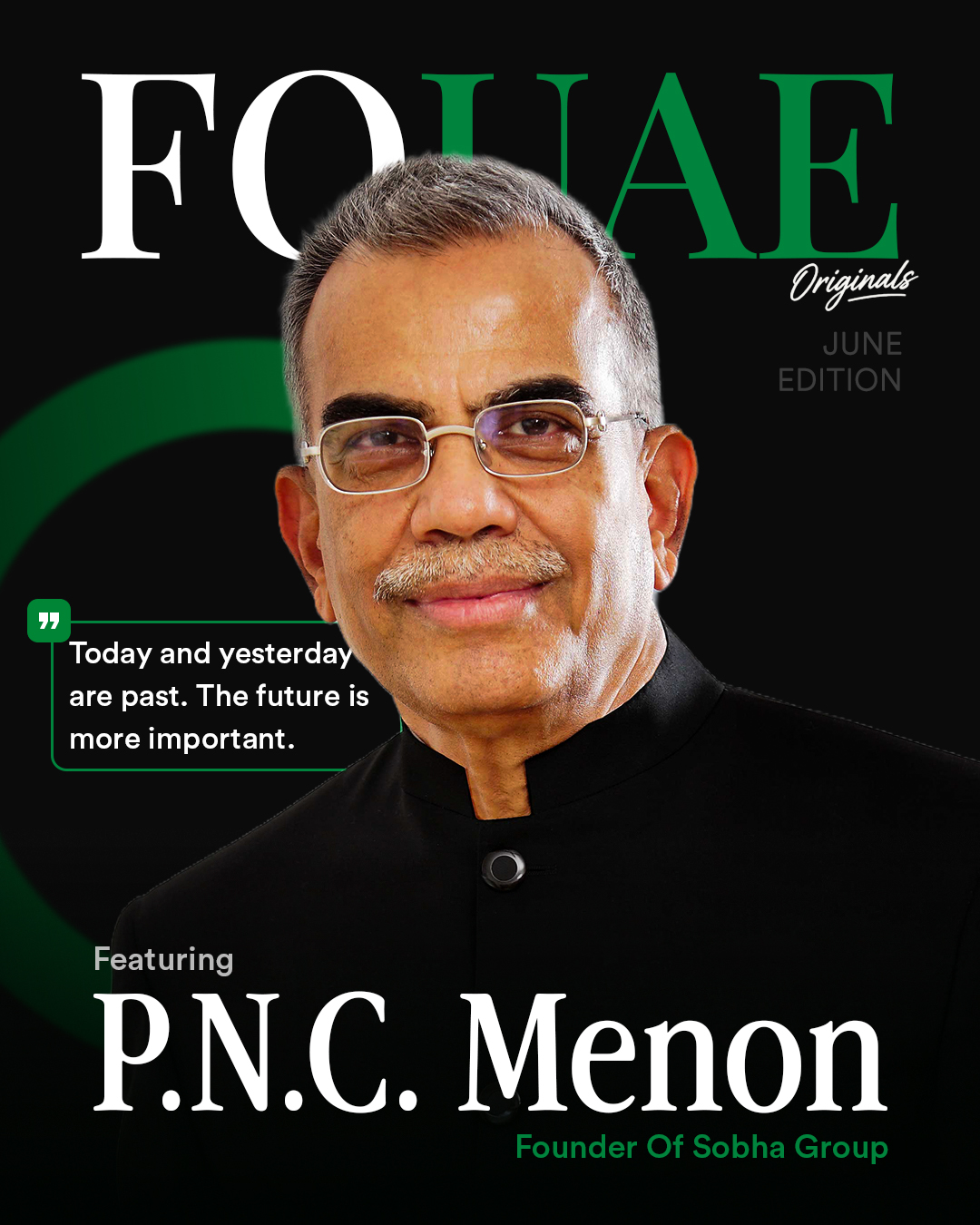
Fifty years later, Puthan Naduvakkatt Chenthamaraksha Menon, known to the Gulf and India simply as P.N.C. Menon, sits on top of a real estate group that employs 50,000 families across Oman, the UAE, Bahrain, and India. His net worth is over three and a half billion US dollars. The Burj Khalifa is not his building, but several of the most prestigious palaces and mosques in the Middle East are quietly his work.
It all started with a conversation he almost didn’t have.
Palakkad, 1958
Menon was born on 17 November 1948 in Palakkad, Kerala. He was the fourth of five children. When he was 10 years old, his father died.
The household that remained could not have been a more difficult starting point for a future industrialist. An illiterate grandfather. A frequently ill mother. Five children with no income. Menon became the family’s earner long before he was ready to be anyone’s earner. The dream of finishing his education at Sree Kerala Varma College quietly died with his father.
He learned interior decoration the way most poor Indians have always learned trades, by doing it. He started a small interior business in Kerala. It was not glamorous. It was not scalable. It was just enough to keep his family fed.
By 1976, he was 27, still running that small operation, still feeling the ceiling of what was possible in small-town Kerala in the mid-1970s.
Then the Captain walked into the lobby.
Muscat, 1976
In Muscat, Menon met up with the partners Captain Adawi had connected him to, and the small group borrowed 3,000 Omani riyals, roughly Rs 75,000 at the time, from a local bank. They opened a street-side furniture and interiors outfit called Trade and Services Co.
Menon’s own description of those early days is unromantic. “Initially, it was a briefcase business. Trying to fix small things, maintenance, et cetera. And then it developed into an interiors outfit.”
The crucial decision was who he chose to chase as customers. Most contractors in newly-rich Muscat were trying to win as much volume as possible, undercutting each other on price. Menon went the other way. He decided his small outfit would target the ultra-affluent. It was a strange call for a 27-year-old immigrant with no track record. It worked because Menon backed his price point with delivery.
Within four to six years, his most important client was the Diwan of Oman, the office that runs the Sultan’s affairs. By the late 1980s, the trail of palace projects led across the Gulf. The ruling family of the UAE. The ruling family of Bahrain. The ruling family of Qatar. The Sultan of Brunei. Each one was a referral from the last. His clients were not the kind to leave Google reviews. They told each other.
The crowning project of this era was his work on the Sultan Qaboos Grand Mosque in Muscat. He also delivered the interiors of Al Bustan Palace, Oman’s most famous royal guesthouse. By the 1990s, P.N.C. Menon was, by quiet consensus across the Gulf, the most trusted craftsman in the region.
Bangalore, 1995
In 1995, Menon returned to India to start a new company. He named it Sobha, after his wife.
It is worth pausing on what he built one year before, in 1994. Before founding Sobha Developers, he set up the Sri Kurumba Educational and Charitable Trust, named after the family deity in his home village. He built the giving vehicle before he built the building company. That ordering says more about Menon than any business decision he made afterwards.
Sobha’s earliest premium projects in Bangalore were residential. The model that drew attention was Menon’s insistence on what is now called “backward integration.” Sobha would not outsource the things its competitors outsourced. It would have its own carpentry workshop. Its own furniture factory. Its own glass and glazing operation. Its own brick and concrete supplies. If something went into a Sobha home, Sobha controlled the quality of how it was made.
Most developers laughed at the model. By 2019, Harvard Business School had written a case study on it.
The House That Caught Narayana Murthy’s Eye
The validation that mattered most to Menon did not come from Harvard. It came from one walk.
In the mid-2000s, N.R. Narayana Murthy, the founder of Infosys, walked through a Sobha residential project in Bangalore called Sobha Sapphire. He stopped. He asked who had built it. Around 2008, Infosys gave Sobha its first campus contract. The relationship that followed has built, among other things, the Infosys Global Education Centre in Mysore. Spread across the wider 337-acre campus, that one building is, by built-up area, the largest monolithic structure constructed in independent India. Over a million square feet under one roof. Designed by Hafeez Contractor. Built by Sobha.
Today, when 16,000 Infosys engineers walk through those hallways every year, they are walking through a building that exists because, three decades earlier, a Palakkad boy boarded a plane to a country he had never heard of.
The Lesson
In 2016, Menon and his wife Sobha quietly walked into a room in California and signed the Giving Pledge, committing at least half their wealth to charity. They were among the first Indian-origin couples on the list.
The temptation, when you read a story like Menon’s, is to package it as a parable about courage. The boy from Palakkad with Rs 50 in his pocket. The flight to a country he had never heard of. All of that is true, and all of it understates the real lesson.
Menon’s career suggests that the most important professional doors of your life almost never look like doors when they first appear. They look like a coffee in a hotel lobby with a man you have no reason to meet. They look like a luxury apartment a software billionaire happens to walk through.
Opportunity rarely arrives by plan. It arrives by conversation.
The boy from Palakkad asked a question. “Where is the Sultanate of Oman?”
Fifty years later, the answer is everywhere his work stands.