From a Bremen Tower Block to an Apartment in the Burj Khalifa
In 2008, a 23-year-old German-Turkish guy walked into a small café in Al Barsha, Dubai, opened his laptop, and connected to the free Wi-Fi. He had a backpack, a half-finished business plan, and almost no money. The café was, in his words, his first office.
Sixteen years later, he lives in an apartment inside the Burj Khalifa.
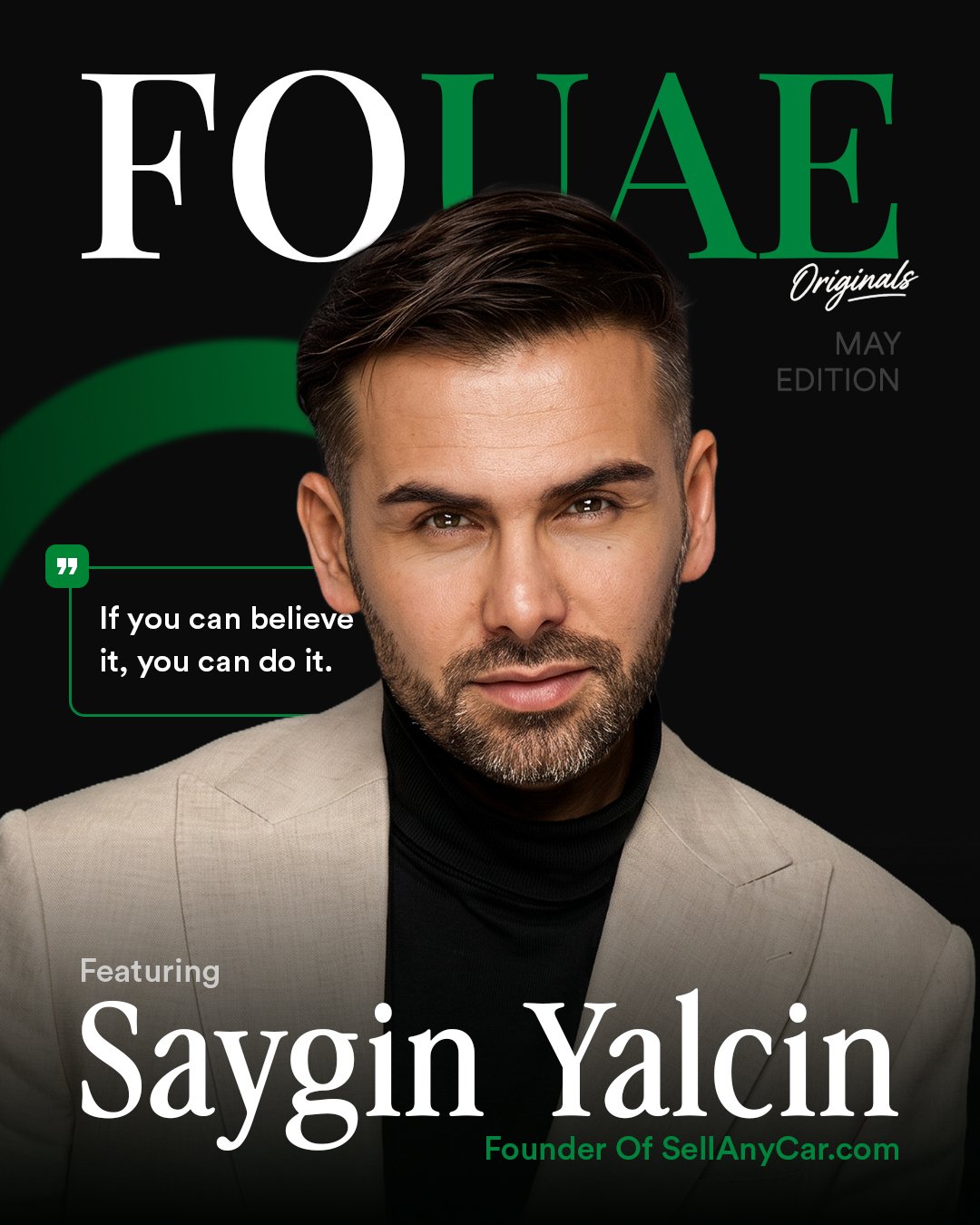
Saygin Yalcin’s story has been told a hundred ways in the UAE press: the influencer with a million followers, the man with the Lamborghini collection, the CEO who hasn’t taken a day off in a decade. But the story underneath those headlines is older and harder. It starts in a working-class tower block in Bremen, with parents who came to Germany on guest-worker visas, and a teacher who told him the best he could hope for was a job selling used cars.
The teacher was right about the cars. He was wrong about everything else.
Bremen, 1985
Saygin was born in May 1985 in Bremen, the son of Turkish Gastarbeiter, the official term for the millions of guest workers Germany recruited from the 1960s onward. The family lived in a Plattenbau, the prefabricated concrete housing that German tabloids later loved photographing him in front of, decades after he had left.
As a teenager, he played football in the A-Junioren Bundesliga, the top tier of German youth football. For a kid from a Turkish immigrant family in Bremen, the dream of going pro was a real one. He gave it up at 19. Not because he wasn’t good enough. Because he had decided he wanted something else.
He moved to New York to learn English, DJ’d in clubs to pay the bills, then enrolled at WHU – Otto Beisheim School of Management, one of Germany’s most respected business schools, picking up a Master’s in Business Administration. Along the way he studied at the Darla Moore School of Business in the US and ITAM in Mexico. By his mid-twenties, he was fluent in Turkish, German, English, and Spanish.
His first jobs were at BMW, then L’Oréal, then Capgemini. On paper, it looked like the corporate fast track. He hated it. He started a fashion brand for women in Germany with two friends. It failed. Wrong product, wrong moment, no money. Most founders never publicly admit their first failure. Saygin built a personal brand on his.
The Café in Al Barsha
In 2008, at 23, he packed a backpack and got on a plane to Dubai.
It was the worst possible year to arrive. Property prices were collapsing, expats were leaving, half-finished skyscrapers were freezing on the skyline. Most rational people his age were running away from the UAE. He was running toward it. His own description, repeated for years afterward: “I came here with a backpack. I had literally nothing. I had an idea though.”
He found a café in Al Barsha with reliable Wi-Fi, sat there day after day, built the pitch deck, called potential investors, recruited his first employees. He worked in a restaurant for six months to keep himself alive.
In 2009, he launched Sukar.com, the Middle East’s first online private shopping club. In his own book, Saygin says Sukar generated 1.1 million US dollars in its first eight weeks. By October 2011, the company had crossed one million members. By April 2012, Souq.com had acquired it. Saygin became a partner at Souq.com and Jabbar Internet Group.
Five years later, in 2017, Amazon acquired Souq.com for 580 million US dollars, its largest acquisition ever outside the United States at the time. Saygin had held his stake the entire way through.
The Six Weeks That Built SellAnyCar
The Sukar exit would have been a comfortable retirement story for most people. Saygin found it boring.
In 2013, he tried to sell his own car. He went on online classifieds, posted his listing, and waited. “I talked to nineteen people in six weeks, and I realized that this job is very annoying.”
Most people would have sold the car and moved on. Saygin started writing. He spent months conducting around 50 expert interviews with sellers, dealers, mechanics, valuators, insurance and finance people, anyone in the used-car value chain who would give him an hour.
When he finally decided to move, he moved fast. “Before going into any business I’m probably one of the slowest people you could imagine. But when I decide to go into a business, I’m one of the fastest.”
In September 2013, he launched SellAnyCar.com with a promise no one in the GCC had dared make: “We will buy any car. In 30 minutes. Cash.”
The first month did 470,000 euros in revenue.
The Auction Hiding in the Phone
The original SellAnyCar model was straightforward. Buy cars from sellers, resell them to dealers. But within months, Saygin’s team noticed something nobody had planned for. When they were about to buy a car, dealers were already calling them, trying to outbid each other for inventory they didn’t yet own. The dealers were doing the auction manually, over WhatsApp and voice calls.
Saygin’s team built the auction into the platform.
Today, when a customer brings a car into a SellAnyCar inspection centre, thousands of dealers receive the listing in real time, bid against each other, and the seller walks out with cash in 30 minutes. By 2019, SellAnyCar had crossed AED 1 billion in gross merchandise value. By the time Saygin started talking about it on stage, the platform had evaluated 3 million cars worth around 15 billion USD.
The Post
Years after the boy in Bremen left home, he posted this online:
“I came to Dubai with a backpack. This is to my teacher who said I would at most become a used car trader. Well, he was right. We are now the largest in the country, after evaluating 3 million cars worth 15 billion USD. This is to the bullies, who laughed at me not having the best clothes growing up. Well, we have built the first and largest online fashion store in the Middle East, then merged with Souq.com, which has been bought by Amazon.com last year, in its largest acquisition ever outside the US. Don’t let haters ever stop you. Make them motivate you. Never hate back.”
The Lesson
Saygin’s philosophy, the one he keeps coming back to in his book and his talks, is deceptively simple.
“Building businesses is a craft like carpentry. If you know how to build, it doesn’t matter if the product is a table or a chair.”
The point is that the product is interchangeable. What is not interchangeable is the craft. The unglamorous discipline of watching consumer behaviour, doing the unfashionable 50-interview research, validating before you build, and then, when it’s time to move, moving faster than your competition can react.
He went from selling discounted fashion online to buying used cars in 30 minutes because the model was the same model. The category was just the surface.
One backpack. One café table. One refusal to believe his teacher.
The boy from the Bremen Plattenbau now lives in the Burj Khalifa. He is still building.