How a 22-Year-Old Architecture Student Made the Building the Billboard
At 4 a.m. on a night sometime around 2014, an architecture student at the American University of Sharjah was hunched over a model, sweeping a thin metal blade across a sheet of cardboard. He misjudged the angle. The X-Acto knife slipped. It cut his hand deep enough to leave a scar he still carries.
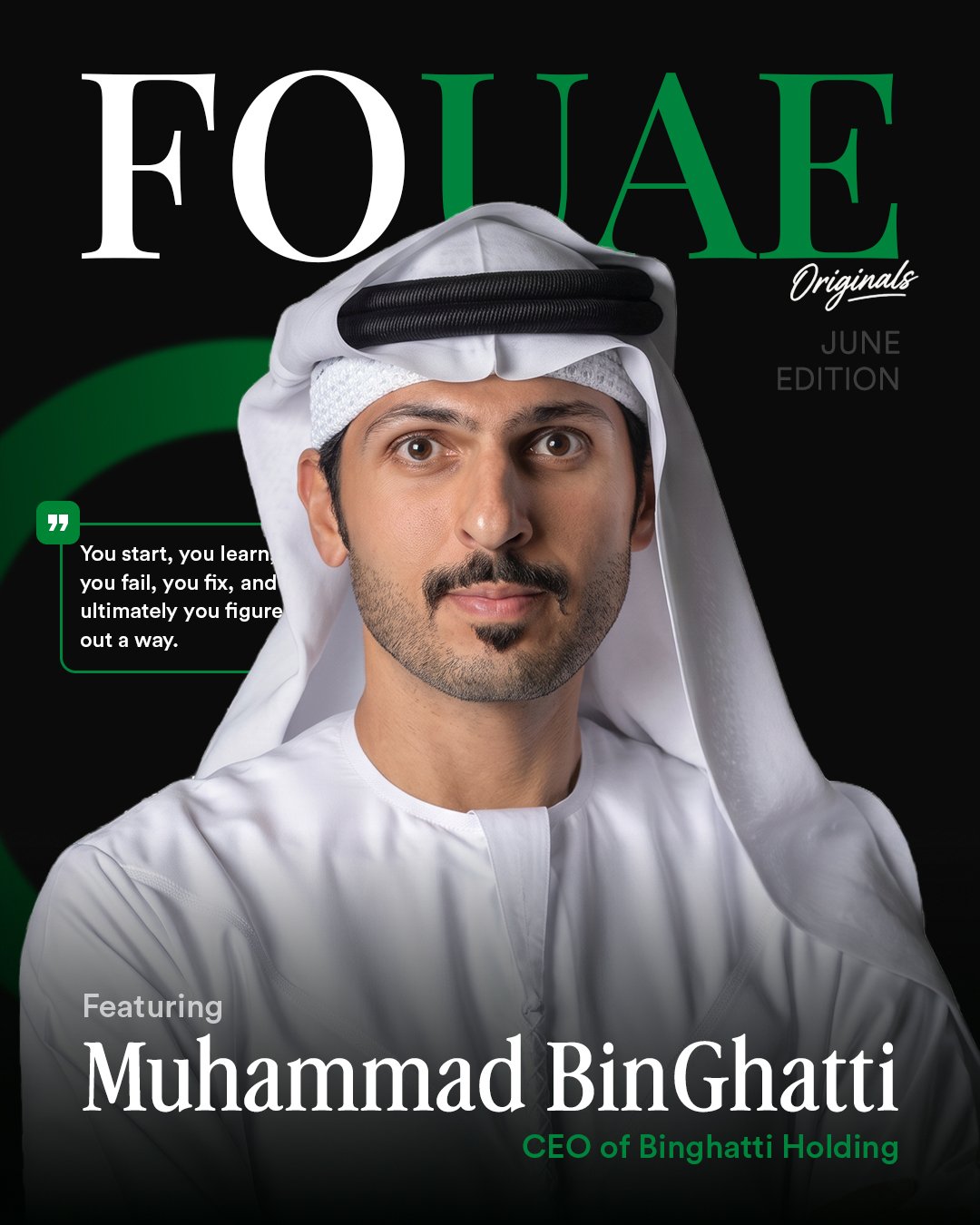
His name was Muhammad BinGhatti. He was 22 years old. He was, that same semester, running a real estate company.
The duality was not theoretical. While his classmates rehearsed final presentations, Muhammad was simultaneously the CEO of Binghatti Holding, the property arm of his father Hussain’s group. By his own description, he was “Chief Executive Officer, Chief Marketing Officer, Chief Sales Officer and Chief Design Officer all combined in one.”
Twelve years later, that company is one of the largest private property developers in Dubai. It carries a portfolio valued north of AED 70 billion. In 2025, it sold over 17,000 units and ranked first in the city’s off-plan market, surpassing every public and private competitor on Dubai Land Department’s books.
The decision that built it was made in his second year of university.
The Boy from a Bedouin Line
Muhammad BinGhatti’s grandfather was a nomadic Bedouin merchant. His father, Hussain BinGhatti Aljbori, was already overseeing construction projects by the time he was 16. In 2008, Hussain founded Binghatti Holding as an umbrella for his various business interests.
For its first six years, Binghatti was profitable, established, and ordinary. It built buildings. It made money. It looked, from the outside, like a small family contracting firm of the type Dubai had dozens of.
In 2014, Muhammad joined his father’s company while still studying architecture. He looked at the project pipeline and decided he was going to build something else entirely.
He did not have the budget of Emaar. He did not have the land bank of Damac. He did not have the brand recognition of Nakheel. What he had was a pen and a clear thesis.
If he could not outspend the city’s giants on marketing, he would make Binghatti’s buildings the marketing.
The Building Became the Billboard
Muhammad gave his team one rule. Every Binghatti building had to be recognisable from a single glance. Not from the lobby. From the road, at speed, by a child.
He killed the highway billboards. He killed the magazine spreads. He took the marketing budget and pushed it into facade design, repetitive geometric balconies, bold cantilevers, and a stubborn family resemblance across every project. Years later, he would explain it in his own words: “I don’t spend the marketing budget on billboards across highways as the buildings themselves are our billboards.”
His analogy for the strategy was a car dealership. “In a Mercedes-Benz dealership, there’s an S-Class, a C-Class and an E-Class. You can tell they’re a family of cars made by the same manufacturer, and we use the same logic. When you look at the Binghatti Views tower, Binghatti Sapphire or Binghatti Vista, there’s a brand DNA. If you say ‘Binghatti’ in front of anyone they’ll know what it is.”
It was a bet that brand recognition built on facade memory would compound faster than recognition bought on a hoarding. Around Dubai, kids started pointing at his buildings by name.
The Luxury Brand Pivot
By 2022, Muhammad had taken his thesis a step further. If Binghatti was already a recognisable design brand, the next move was not to build alone. The next move was to co-sign.
In November 2022, at the Coca-Cola Arena in Dubai, Binghatti announced a partnership with the watch and jewellery house Jacob & Co. to develop Burj Binghatti Jacob & Co. Residences, a tower aspiring to become the world’s tallest residential building.
Then came Bugatti. Then Mercedes-Benz.
Binghatti became the first real estate developer in the world to forge residential partnerships with hypercar makers and haute horology houses. Most luxury collaborations in property at the time were superficial, just a logo on a lobby wall. Muhammad insisted on co-designed projects where the partner’s design language flowed into the architecture, the interiors, the amenities, and the lifestyle on offer.
The market accepted it faster than even he expected.
The Penthouse, the Footballer, and the Tenor
On 12 December 2025, Binghatti’s Chief Sales Officer Abdullah Binghatti closed a single transaction at Bugatti Residences in Business Bay. AED 550 million. Spanning 47,200 square feet. At AED 11,650 per square foot, it was the highest per-square-foot price ever recorded in Business Bay, and the most expensive penthouse ever sold in Dubai or the Middle East.
By then, the resident list at Bugatti Residences already included footballer Neymar Jr., Italian tenor Andrea Bocelli, and footballer Aymeric Laporte.
A few kilometres away, Burj Binghatti Jacob & Co. Residences was rising in Business Bay. Above-ground construction commenced in February 2025. The planned height: 557 metres across 104 floors. When complete, it will surpass New York’s Central Park Tower as the tallest residential building in the world. Five of its top-floor penthouses are types Muhammad named himself: Fleurs de Jardin, Astronomia, and the Billionaire Sky.
What the Architect Learned
Today, Binghatti’s portfolio includes more than 80 projects valued at over AED 70 billion. The company has delivered more than 12,000 residential units. It holds credit ratings from Fitch and Moody’s. In 2025, it sold over 17,000 units, the most of any developer in the city. In December 2025, Forbes Middle East ranked Muhammad among the region’s top real estate leaders.
He is 33 years old.
The lesson in his story is not that he inherited well. Plenty of Dubai founders have inherited a family construction firm and quietly run it for a generation. The lesson is what he did with the budget on his first day.
He did not spend it on being seen. He spent it on being unforgettable.
The buildings did the advertising. The signature became the moat. By the time the city’s bigger developers noticed what was happening, a kid with a scar on his hand had built a private empire by simply refusing to design a building that looked like anyone else’s.
Today, you can spot a Binghatti from a mile away.
That was the entire point.