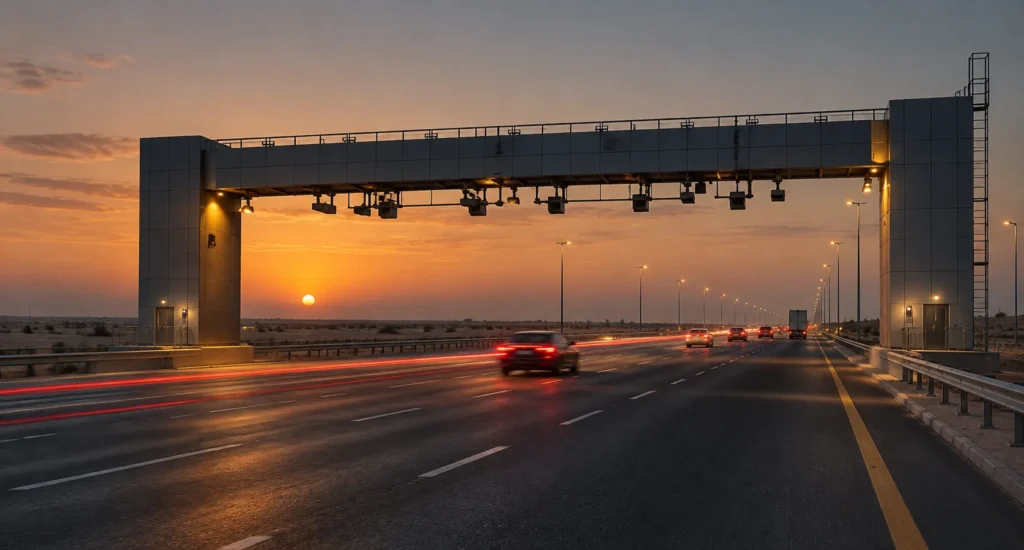
- What Salik revenue actually did in H1 2026
- Why the margin barely moved
- Fines are taking a bigger share of Salik revenue
- Variable pricing works against Salik revenue
- RTA takes its cut first
- So who is Salik run for?
- The counterargument worth taking seriously
- What Salik revenue means for investors and operators
- What to watch next
- Frequently Asked Questions
- Sources
Salik revenue fell 7.7 percent to AED 1,412.0 million in the first half of 2026, yet the EBITDA margin slipped just 0.6 points to 69.1 percent. Chargeable trips dropped 12.5 percent. So Dubai drove a lot less, and the toll operator barely felt it.
That gap is the whole story. A toll gate costs the same whether one car passes or a million. And one revenue line grew while the core shrank.
What Salik revenue actually did in H1 2026
First, the headline set. Salik Company PJSC, the sole operator of Dubai’s toll gates, reported H1 2026 revenue of AED 1,412.0 million, with EBITDA of AED 975.6 million and net profit of AED 704.0 million.
Next, the traffic. Total trips came to 383.8 million, down 9.5 percent from 424.2 million a year earlier. Chargeable trips fell harder still, by 12.5 percent to 278.5 million. Toll usage fees, the core line, dropped 11.4 percent to AED 1,202.5 million.
The cause was the regional disruption that began in late February 2026. Traffic then rebounded through Q2, and CEO Ibrahim Sultan Al Haddad said June returned to near-normal levels.
For scale, look at the prior year. Salik posted FY2025 revenue of AED 3.10 billion, up 35.1 percent, with net profit of AED 1.55 billion. So H1 2026 is a dip inside a steep growth run, not a slide from a flat base. Active registered accounts also reached 2.9 million by June 2026, so the paying base kept widening even while trips fell.
Why the margin barely moved
Now the interesting part. Chargeable trips fell 12.5 percent. The EBITDA margin went from 69.7 percent to 69.1 percent, a loss of 0.6 points.
In short, that is what a toll asset looks like. Costs sit in gantries, software and staff, and none of them scale with traffic. So volume shocks hit the revenue line almost fully, while the margin holds.
The FOUAE calculation
Revenue per chargeable trip actually rose slightly, from about AED 4.26 in H1 2025 to about AED 4.32 in H1 2026, a gain near 1.3 percent. So Salik earned marginally more from each paying car even as fewer cars came.
Treat these as derived figures, since Salik reports percentage changes rather than prior-period line items.
Fines are taking a bigger share of Salik revenue
Here is the line nobody has pulled out. Toll usage fees fell 11.4 percent. Fines revenue rose 7.5 percent to AED 144.4 million.
So penalties now make up about 10.2 percent of Salik revenue, against roughly 8.8 percent a year earlier. In Q2 2026 alone, fines climbed 14.2 percent to AED 75.2 million and reached 11.0 percent of quarterly revenue.
Run it per trip. Fines worked out near AED 0.32 per trip in H1 2025. In H1 2026 they reached about AED 0.38, a rise of roughly 19 percent while total trips fell 9.5 percent.
For context on the base, Salik logged about 786,000 net violations in Q1 2025, near 0.4 percent of net toll traffic. So a very small slice of trips carries a growing slice of the revenue.
That is worth sitting with. As Dubai drove less, the share of Salik revenue coming from fining drivers went up, not down.
Variable pricing works against Salik revenue
Dubai switched to variable tolling on 31 January 2025. Peak trips cost AED 6, while off-peak trips cost AED 4. The stated aim is smoother traffic, not more income.
So far it is working. In H1 2026, peak trips reached 102.9 million and off-peak trips reached 146.2 million. So about 59 percent of priced trips happened in the cheaper window.
Read the incentive carefully. Every driver who shifts from 08:00 to 11:00 helps the road and costs the toll line AED 2. The tool that serves Dubai’s traffic policy therefore works against Salik revenue by design.
RTA takes its cut first
Meanwhile the landlord raised the rent. Salik pays the Roads and Transport Authority a concession fee, and that fee rose from 22.5 percent to 23.1 percent of revenue.
Therefore apply the new rate to H1 2026 revenue and roughly AED 326 million goes to RTA before Salik pays a single operating cost. Gulf News reported the increase as one reason the margin narrowed.
So the fee went up in a falling half. That is the behaviour of an owner, not a regulator balancing a licensee’s returns.
So who is Salik run for?
Three parties hold claims, and they do not want the same thing. RTA wants less congestion and a rising concession cut. Dubai’s economic model wants roads that work as the population grows. Shareholders want trips.
In practice, Salik resolves this by being a policy instrument with a listed wrapper. Dubai sets the price, takes its share first, and keeps the congestion lever. Public investors get the residual.
Still, that residual is unusually good. It is stable, high-margin, and it pays out. In H1 2025 the board approved a dividend of AED 770.9 million, or 10.278 fils per share, matching 100 percent of half-year profit. But it is a residual, and the order matters.
The counterargument worth taking seriously
The bull case is real. First, this was a demand shock, not a structural break. Traffic was near normal by June 2026, and the same gates still serve a growing city.
Second, growth drivers remain. Al Haddad pointed to “Dubai’s continued population growth, economic expansion and long-term urban development”. More residents and more cars mean more trips, and tourism recovery adds to that.
Third, management has expanded the network. Chairman Mattar Al Tayer credited 2025 growth partly to “the successful introduction of two new toll gates”. So new gates raise trips without raising the toll.
Fourth, a 69 percent EBITDA margin through a bad half is evidence of quality, not extraction. Few listed assets anywhere hold that.
What Salik revenue means for investors and operators
Model trips, not tolls. Because the price is set by policy, trip counts are the only variable you can forecast. Watch monthly traffic, not rate cards.
Treat the concession fee as a live risk. It moved once. It can move again, and it lands straight on margin.
Fleet operators should reprice peak delivery. A quick commerce or logistics business crossing gates all day pays AED 2 more per peak crossing. Shifting slots is a real saving.
Read fines as a cost line, not a rounding error. Penalties are growing faster than tolls, so tag balances and plate records deserve actual process.
What to watch next
Three markers carry thresholds. First, whether total trips return above 424 million in a half, which would mark a full recovery to H1 2025 levels.
Next, whether fines fall back under 9 percent of revenue. If they do not, the mix shift is structural rather than a slow half. Last, whether RTA moves the concession fee again, because that single number decides how much of Salik revenue reaches shareholders.
The answer to the question is plain. Salik revenue belongs to Dubai first and to investors second, and the H1 2026 numbers show exactly how that order works in a bad half.
Frequently Asked Questions
Salik reported total revenue of AED 1,412.0 million for the first half of 2026, or 7.7 percent below the prior year. EBITDA reached AED 975.6 million at a 69.1 percent margin, while net profit came to AED 704.0 million, a margin of 49.9 percent.
Mainly because traffic dropped after the regional disruption that began in late February 2026. Chargeable trips fell 12.5 percent to 278.5 million, and toll usage fees fell 11.4 percent. Salik said traffic recovered through Q2, with June near normal.
In total, fines brought in AED 144.4 million in H1 2026, about 10.2 percent of total revenue, up from roughly 8.8 percent a year earlier. In Q2 2026 fines reached 11.0 percent of quarterly revenue, rising 14.2 percent year on year.
Dubai charges AED 6 at peak and AED 4 off peak, from 31 January 2025. In H1 2026, about 59 percent of priced trips fell in the cheaper window. So the policy eases congestion while capping the revenue each trip earns.
Sources
Sources: Salik Company PJSC H1 2026 results, 6 August 2026, via Zawya and Gulf Today; Salik Q1 2026 results, 11 May 2026, via Dubai Media Office and Gulf News; Salik FY2025 and H1 2025 results, via Gulf News. Revenue per chargeable trip, fines per trip, the fines share of revenue, the off-peak share of priced trips and the AED 326 million concession figure are FOUAE calculations from published aggregates and percentage changes. Salik reports year-on-year percentages rather than every prior-period line, so prior-year figures here are derived and should be read as close estimates. This is general analysis, not investment advice.
Founders of UAE (FOUAE) is an independent, digital-first business publication covering the founders, companies and economy of the United Arab Emirates. Follow FOUAE on Instagram and LinkedIn.