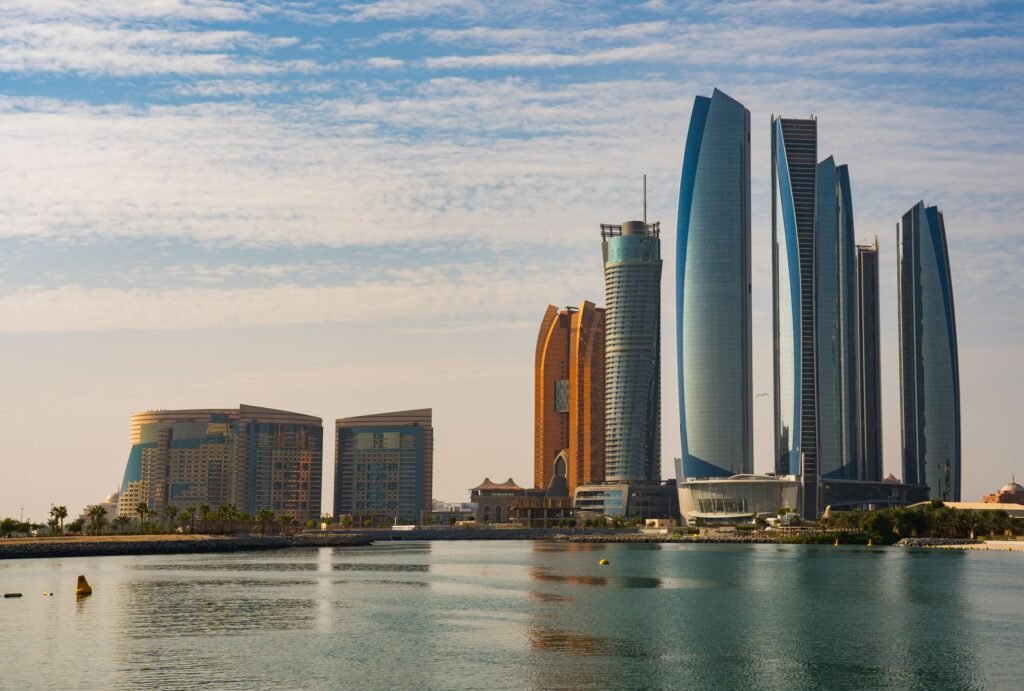
For two years, the loudest question in regional business has been Dubai versus Riyadh. It is the wrong rivalry to obsess over. A quieter and arguably more consequential shift has been unfolding ninety minutes down the E11 motorway, inside the UAE itself. Abu Dhabi is becoming the preferred base for the largest, most institutional pools of capital in the region, while Dubai retains its command of ecosystem density, speed, and sheer entrepreneurial volume.
This is not a story about one city beating another. It is a story about specialisation, and understanding which emirate now serves which kind of capital is a far more useful framework than treating “the UAE” as a single, undifferentiated market. The founders and investors who read the two cities as interchangeable are the ones most likely to base themselves in the wrong place.
The gravitational pull of sovereign capital
Start with the number that frames everything. Abu Dhabi is estimated to hold around $1.7 trillion in sovereign wealth, a concentration that, according to Global SWF, has surpassed Norway to become the largest anywhere in the world. The emirate has taken to branding itself, without much modesty, as the “capital of capital.”
That wealth is spread across a handful of enormous vehicles: the Abu Dhabi Investment Authority, set up in 1976 to invest the emirate’s surplus oil revenues, alongside Mubadala and ADQ. Sitting beneath the sovereign funds is a growing layer of state-linked institutional managers, most notably Lunate, the Abu Dhabi investment house overseeing roughly $110 billion across private equity, venture, credit and other mandates. This is capital measured in nine, ten and eleven figures, and it does not move for lifestyle reasons. It anchors an ecosystem.
The effect on global finance has been direct. When the world’s largest allocators of capital want proximity to that money, they set up where it lives. That is why ADGM, Abu Dhabi’s financial free zone on Al Maryah Island, has become a magnet for the most institutional end of the market.
Why ADGM pulls the institutions
ADGM’s appeal rests on a specific combination that the most demanding managers value. It operates under English common law with its own independent courts, the same legal tradition used in London, Singapore and Hong Kong, which means contracts, trusts and disputes behave the way international investors expect. It offers efficient holding and special-purpose-vehicle structures suited to family wealth and fund formation. And it sits within arm’s reach of the sovereign pools.
The names that have arrived tell the story. The macro hedge fund Brevan Howard now runs roughly $10 billion out of Abu Dhabi, more than it manages from either London or New York, and secured a $2 billion platform commitment from Lunate. Marshall Wace, Man Group, Balyasny, BlackRock, PGIM and Nuveen have all established or expanded ADGM operations. One hedge fund executive who relocated from London captured the mood, telling the Financial Times that Abu Dhabi carries a similar energy to Hong Kong two decades ago.
The physical infrastructure is straining to keep up, which is itself a signal. Office occupancy on Al Maryah Island reached 97 percent, prompting authorities to approve a roughly $16 billion expansion, jointly developed by Mubadala and Aldar, that will double the supply of top-grade office space and add residential and retail districts.
The cost and density trade-off
Where the two financial free zones genuinely diverge is in cost and ecosystem depth, and this is where the specialisation becomes concrete.
ADGM is the cheaper and, for many structures, the faster option. Its 2025 to 2026 fee schedule sets non-financial company registration at around $5,500, with FSRA regulatory fees running materially below DIFC’s equivalent DFSA fees, and setup for standard entities typically completing within three to six weeks. Advisers put ADGM at roughly 20 to 30 percent cheaper than DIFC for comparable operations. It also runs a well-regarded regulatory sandbox, RegLab, that lets fintech and digital-asset firms test regulated products under lighter requirements before graduating to full authorisation.
DIFC’s advantage is not price but density. By the end of 2025 it hosted 8,844 active companies, including more than 290 banks and capital-markets institutions and over 500 wealth and asset managers. For a business that needs immediate commercial proximity to peers, service providers, private banks and fund administrators, that concentration is worth paying for. ADGM’s smaller, more curated environment can mean faster regulator access, but it cannot yet match DIFC’s on-the-ground ecosystem.
The honest case for Dubai
None of this diminishes Dubai, and an analysis that declared Abu Dhabi the winner would be misreading the evidence. Dubai remains, unambiguously, the entrepreneurial engine of the country.
The funding data makes this stark. Dubai-based tech firms accounted for roughly 96 percent of all UAE tech funding in the first quarter of 2025. The city hosts more than 3,500 active startups, and the UAE as a whole, driven overwhelmingly by Dubai, remains the largest recipient of venture funding in the MENA region, accounting for a plurality of the region’s VC-eligible startups. Dubai offers the talent density, the networking cadence, the market access across the GCC and beyond, and the founder-to-founder recycling of capital and experience that a young company actually needs.
Abu Dhabi is closing part of this gap deliberately. Its ecosystem value reached $73.4 billion between mid-2023 and the end of 2025, according to Startup Genome, and Hub71, backed by a Mubadala fund, has anchored a genuine venture-stage push into AI, fintech and digital assets. But the point stands: for the venture-backed company chasing speed and market access, Dubai is still structurally better suited.
A framework, not a verdict
The useful conclusion is a decision rule rather than a ranking.
A family office managing nine or ten figures, a hedge fund seeking a common-law jurisdiction with minimal bureaucratic friction, or a founder who wants proximity to sovereign co-investment is increasingly well served by Abu Dhabi. The gravitational pull of $1.7 trillion in sovereign wealth, the common-law courts, the efficient holding structures and the deepest institutional relationships all point in that direction.
A startup that needs talent density, fast licensing, a large peer community and immediate commercial market access remains better served by Dubai. The 96 percent share of national tech funding is not an accident. It reflects where the ecosystem, the operators and the early-stage capital physically sit.
The deeper insight for anyone building or allocating in the Emirates is that the old shorthand has expired. “The UAE” is no longer one market with two addresses. It is two distinct capital ecosystems operating thirty minutes apart by air and about ninety by road, each optimised for a different kind of money and a different kind of ambition. The strategic error is not choosing Abu Dhabi over Dubai, or the reverse. It is failing to notice that the choice now carries real consequences, and picking on reputation rather than on the specific nature of the capital you hold or seek.
Sources: Global SWF data via Business Standard and Caliber.az, 2024 to 2025; Spears WMS, Abu Dhabi entrepreneurs and Abu Dhabi’s first home-grown hedge fund, 2024 and April 2026; WealthBriefing, Abu Dhabi-backed firm acquires Brevan Howard stake, August 2025; Bloomberg, Abu Dhabi Reshapes Finance, December 2025; Hedgeweek, Abu Dhabi plans $16bn hedge fund hub expansion, December 2025; The National, Global investors with $20tn press ahead with Middle East expansion, April 2026; Navira Corporate, DIFC vs ADGM fee schedules 2025 to 2026; Kayrouz & Associates, Fintech Company Setup UAE, March 2026; Growth List, 500+ Funded UAE Startups, March 2026; Waveup, Top Investors and VC Firms in Dubai, 2026; Startup Genome via Entrepreneur Middle East, Abu Dhabi enters world’s top 50 startup ecosystems, 2026.