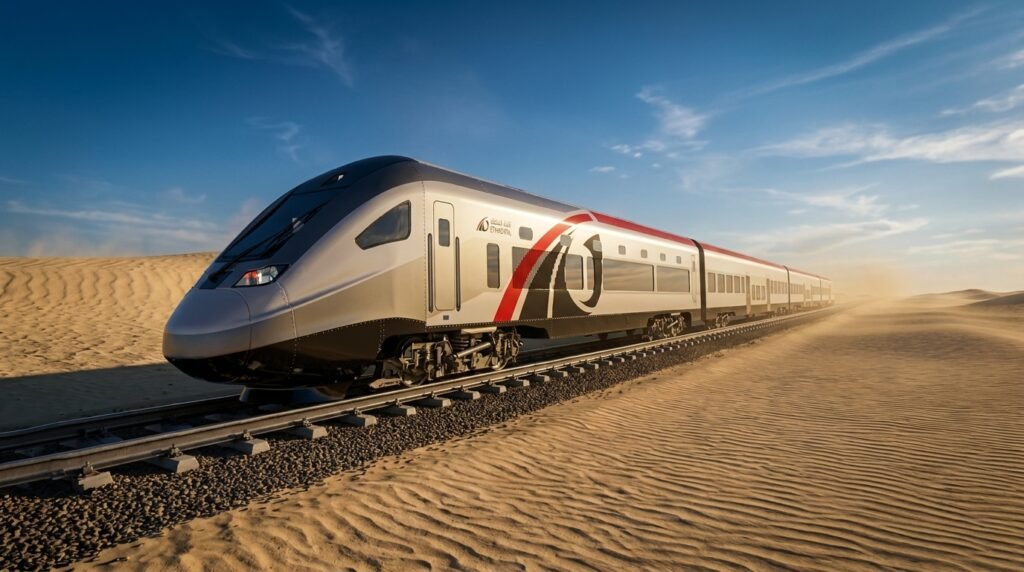
At 5:34 on the morning of 30 June 2026, the first Etihad Rail passenger train pulled out of Al Hilal City in Fujairah and arrived at Abu Dhabi’s Mohammed Bin Zayed City station one hour and forty-five minutes later, about twenty minutes ahead of schedule. The demand had already made the point. Within two days of bookings opening on 23 June, 5,000 passengers had reserved seats, all three launch-day services had sold out, and more than 10,000 tickets were gone before operations even began.
It is tempting to file this as a transport story. That would miss what is actually happening. Etihad Rail is quietly rewiring the UAE’s economic geography, and the consequences for where businesses locate, where families live, and where capital flows have barely been analysed.
The facts of the launch
The introductory phase connects Abu Dhabi and Fujairah on a journey of 105 minutes, operated by a fleet of 13 trains, each carrying up to 400 passengers at speeds of up to 200 km/h. Passenger services are run by Etihad Rail Passenger Services, a joint venture with the international operator Keolis. Introductory fares, which include a 50 percent launch discount, start from AED 55 in Comfort Class and AED 120 in Premium, and the network is built to carry roughly 10 million passengers a year once fully operational across its 11 stations.
The rollout is deliberately phased, and the timing of each phase carries direct business implications. The Abu Dhabi to Fujairah route is live now. On 30 September 2026, the Dubai station at Jumeirah Golf Estates and the Al Dhaid station in Sharjah open, marking the official full launch of the passenger network. Stations across Abu Dhabi’s Al Dhafra region, including Madinat Zayed, Liwa, Al Mirfa and Al Sila, follow on 30 December 2026. The announced route completes with Sharjah’s University City station on 30 March 2027.
The number that changes everything
The single most consequential figure is not the launch date. It is 57 minutes, the Abu Dhabi to Dubai journey time once that segment opens in September. Dubai to Fujairah will take 69 minutes.
To understand why 57 minutes matters, consider what it replaces. The road journey between the UAE’s two largest commercial centres runs 90 minutes to two hours depending on traffic, unpredictable and tiring, or a short flight with all the friction that airports impose. A fixed-schedule train with guaranteed seating, charging ports and Wi-Fi, completing the trip in under an hour, fundamentally changes the practical commuting radius between the two cities.
The implication is concrete. An executive based in Abu Dhabi, with its deepening advantages as the region’s institutional capital hub, can now realistically attend a morning meeting, a client engagement and an evening networking event in Dubai’s ecosystem-dense environment, and be home the same day, without the friction that previously made the two cities feel more functionally separate than their physical distance suggested. The corridor stops being a choice between two places and starts becoming a single, connected economic zone.
The real estate thesis, stated as a thesis
The property implication is where the analysis has to be most disciplined, because it is a thesis worth watching rather than a settled conclusion. Communities along the rail corridor, including areas near the Dubai station at Jumeirah Golf Estates and the Al Dhafra towns gaining their first meaningful rail connection to Abu Dhabi, may see demand and pricing dynamics shift as their effective commuting distance to major employment centres changes.
The honest caveat is that transit-oriented property appreciation depends on more than a station appearing on a map. It depends heavily on last-mile connectivity, the feeder buses, taxis and shuttle links that carry a passenger the final stretch from platform to door. Etihad Rail already runs a shuttle service from the Abu Dhabi station, and integration with local transport authorities is being built out. Investors should treat corridor real estate as a trend to monitor as that connectivity matures, not as a guaranteed uplift to price into a purchase today.
The secondary cities and the freight backbone
Two quieter effects deserve attention. The first is the opening of the Al Dhafra region. Stations at Madinat Zayed, Liwa, Al Mirfa and Al Sila give places previously reachable only by car a direct link to the national network, with real potential for tourism businesses, hospitality investment and regional development in areas that have historically sat outside the primary Abu Dhabi to Dubai corridor.
The second is freight. The passenger service runs on an existing freight corridor of roughly 900 km stretching from Ghuwaifat on the Saudi border to Fujairah on the east coast. That backbone was the original purpose of the railway, and it means businesses weighing warehouse or distribution locations now have an integrated freight rail option that did not exist in the same form before. For logistics-heavy operations, the location calculus has genuinely changed.
The horizon beyond 2027
What is live today is an early phase, not a finished system. A separate 150 km high-speed line between Abu Dhabi and Dubai, announced in 2025, is designed to cut that journey to around 30 minutes at speeds of up to 350 km/h, and is targeted to open by 2030. Beyond the UAE’s borders, the Hafeet Rail project, a joint venture between Etihad Rail and Oman Rail, will build roughly 300 km of new track connecting Abu Dhabi to the port of Sohar via Al Ain. The passenger network that began operating in June 2026 is the opening move in a substantially larger regional rail ambition.
The strategic reframe
For years, the question of where to base a business or a family in the UAE has been framed as a binary: Abu Dhabi or Dubai. Etihad Rail’s full network, completing through 2027 and expanding well beyond it, makes that framing increasingly outdated.
The more useful question for the next several years is not Abu Dhabi or Dubai, but where along a now genuinely interconnected national corridor a specific business or family’s needs are best served. A founder who wants proximity to sovereign capital and institutional finance can base in Abu Dhabi while tapping Dubai’s ecosystem density within a single working day. A family can weigh a home in a quieter, cheaper corridor community against a station’s commuting reach rather than against a single city’s boundaries. The answer, increasingly, is able to draw on both cities’ advantages at once rather than forcing a trade-off between them.
That is what a railway actually does when it works. It does not just move people faster. It redraws the map of what counts as close, and in doing so it quietly rewrites the location decisions that shape where an economy’s next phase of growth actually happens.
Sources: The National, Etihad Rail Makes Historic Journey From Fujairah to Abu Dhabi, June 30, 2026; Gulf News, 5,000 Passengers Book Etihad Rail Services Within Two Days, and Etihad Rail Tickets: How to Book, June and July 2026; Khaleej Times, Etihad Rail to Begin Introductory Phase on June 30, June 2026; Railway Gazette International, Passenger Train Service Launched in the UAE, July 2026; Etihad Rail official statements via WAM and Gulf News; Wikipedia, Etihad Rail, for network history, Hafeet Rail, and the Abu Dhabi to Dubai high-speed line.