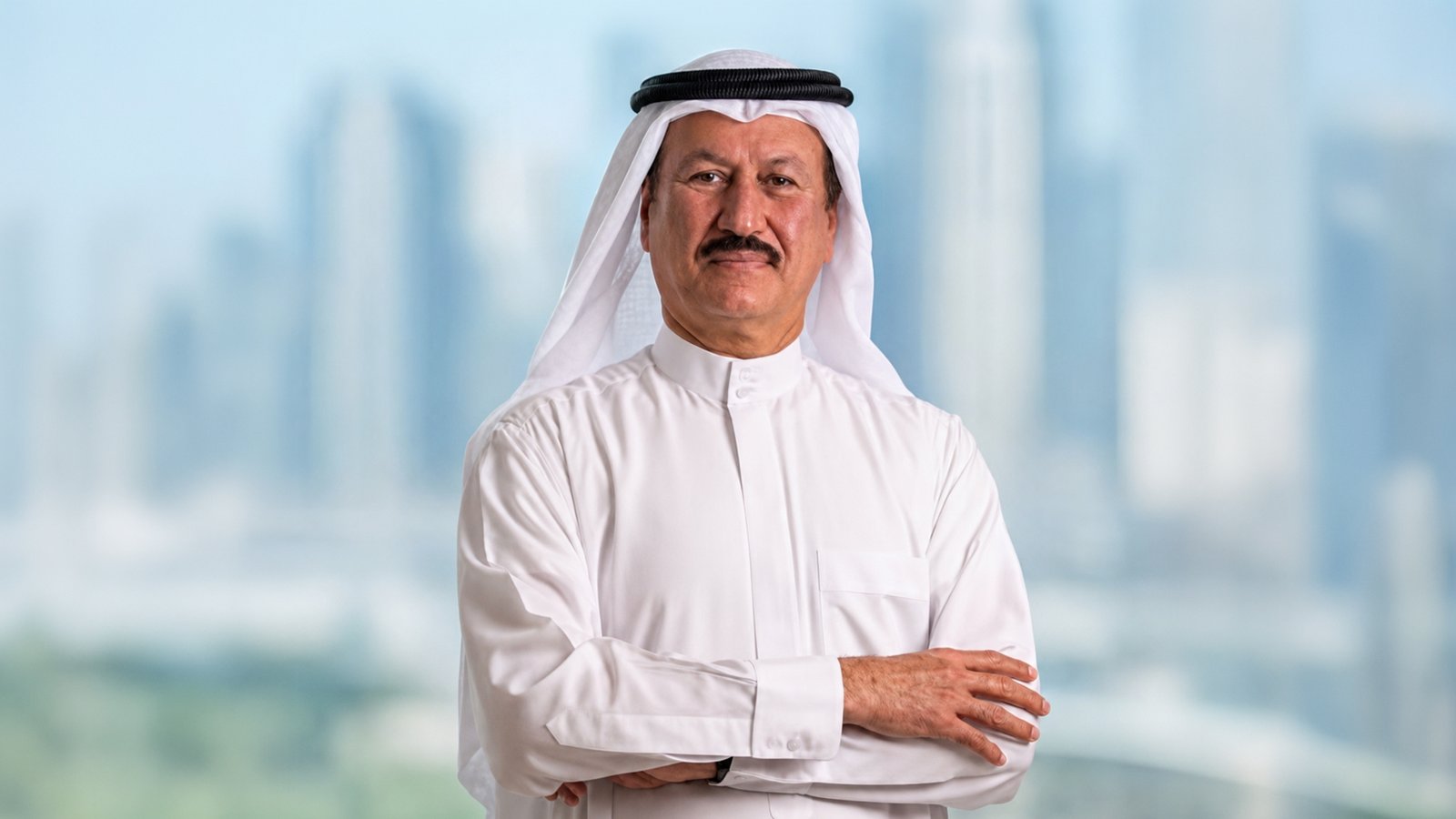
The Boy from the Souk Who Never Missed a Wave
Hussain Sajwani is the Emirati billionaire founder and chairman of DAMAC Properties, which he founded in Dubai in 2002. Born in Dubai in 1953, he built a catering business serving US military forces and Bechtel before entering real estate. He also founded DAMAC Digital, formerly EDGNEX, a data centre platform active in ten countries.
There is a quote that follows Hussain Sajwani around.
I was one of the very few who saw the crisis.
He was speaking about September 2008. He was in London. His weekly DAMAC Properties sales report had just landed, and the number was down 60 per cent year on year. He did not wait for Lehman Brothers to fall. Instead, he got on a plane back to Dubai the same day, started cutting staff, and consolidated his land and projects. By the time the global property market was on fire, his company was already adjusting the hose.
That sentence is a useful one to remember. Because Sajwani’s entire career, from a watch stall in the old Deira souk to a $20 billion data centre commitment announced next to Donald Trump at Mar-a-Lago in January 2025, has been a series of bets placed slightly before everyone else figured out what was happening.
Today, he is one of the richest men in the Arab world. Forbes Middle East estimates his net worth at $15.3 billion. DAMAC booked $9.8 billion in sales in 2025 alone. Its buildings stand in Dubai, London, Miami, Toronto, Riyadh, and, next, Baghdad. He owns Roberto Cavalli. He also owns the Swiss jeweller De Grisogono. His data centre platform is active in ten countries.
This is the story of a boy from a Dubai souk who learned, very early, that the people who win are the ones who walk up to the counter before anyone else knows there is a counter.
The Souk: A Deira Childhood, 1953
Hussain Sajwani was born in Dubai in 1953, the eldest of five children. His father owned a small stall in the local souk, where he sold watches, Parker pens, shirts, and goods imported from China. His mother sold fabrics and household items to neighbours, often door to door.
Sajwani has said in interviews that his first lessons in business were not theoretical. Rather, they were operational. He watched his father set prices. He watched him build trust with regular buyers. Before he learned anything else, he learned that commerce is about relationships, reputation, and small daily decisions made well.
Seattle: University of Washington, 1981
By his late teens, he had earned a government scholarship. His first stop was a medical college in Baghdad. He did one year there before deciding medicine was not for him. Then he transferred to the University of Washington in Seattle, where he studied industrial engineering and economics.
To pay for the cost of living in the US, he sold timeshare apartments back in the UAE.
He graduated in 1981 and came home to a first job as a Contracts Manager in the finance department of Abu Dhabi Gas Industries, a subsidiary of ADNOC. He lasted long enough to realise he did not want a corporate career.
Global Logistics Services: The Catering Empire That Built Everything
In 1982, Hussain Sajwani launched what would become his first fortune. It was a catering business. The timing was, in retrospect, almost suspicious. The Iran-Iraq war was grinding through its second year. At the same time, the Gulf was becoming a permanent military theatre for the United States and its allies.
Sajwani’s company, later renamed Global Logistics Services, would go on to feed US military forces during the first Gulf War, and later in Bosnia, Somalia, and Afghanistan. It also fed Bechtel, one of the largest construction firms on Earth, on their Gulf projects. At its peak, it was serving over 150,000 meals a day across multiple countries.
The catering business still runs today, more than four decades later. But it did something more important than throw off profits. Above all, it gave Sajwani the cash flow to fund every wave he was about to catch.
Most people remember Hussain Sajwani as a real estate developer who got lucky in 2002. They forget that, by the mid-1990s, he had already built several small hotels in Dubai to house the early waves of trading expatriates arriving in the city. He had an insurance firm in Bahrain, and a ceramics factory in Oman. In short, he was quietly running a small, diversified conglomerate.
When the next wave came, he was already standing in the water.
2002: Founding DAMAC Properties
In 2002, the Dubai government announced that foreigners could own freehold property in the emirate for the first time.
Most local developers were still reading the regulation. Meanwhile, Hussain Sajwani had already started acquiring land. He founded DAMAC Properties the same year. His first residential project sold out in under six months.
He understood, very early, that wealthy international buyers did not want a flat. In fact, they wanted a feeling. So he sold them Versace interiors. Cavalli furniture. Fendi-branded apartments. A Trump-designed golf community. A Paramount Pictures hotel tower. And, famously, free Lamborghinis and BMWs to early buyers in flagship projects.
Between 2002 and 2008, Dubai’s property market entered the biggest building boom in its history. DAMAC led it.
2008: The Crash He Saw Coming
Then came the sales report in London.
DAMAC fell harder than most in 2008 because it had grown faster than most. After all, it was the largest private developer in the city. Hundreds of staff were let go. Projects were also suspended. Sajwani has described it as the hardest professional period of his life. But while roughly half of Dubai’s developers disappeared between 2008 and 2010, DAMAC remained one of the few non-state-owned developers still standing when the market came back.
In December 2013, he raised about $348 million on the London Stock Exchange, becoming the first Middle Eastern real estate company to list there via Global Depository Receipts. Then, in 2015, he transferred the listing to the Dubai Financial Market. By 2022, he had taken DAMAC private again, paying around $595 million to buy out minority shareholders.
The official reason was a prolonged slump in the stock price. The unofficial reason, in retrospect, was that he wanted full control of what was coming next.
EDGNEX and DAMAC Digital: The Next Wave
What was coming next was not towers. It was compute.
In 2021, Hussain Sajwani founded EDGNEX, since rebranded as DAMAC Digital. It is a data centre platform now active in the UAE, Saudi Arabia, Turkey, Thailand, Malaysia, Indonesia, Greece, Spain, Finland, and Italy.
On 7 January 2025, two weeks before Donald Trump was inaugurated for his second term as US President, Sajwani stood next to him at Mar-a-Lago and announced a $20 billion investment to build data centres across eight American states. Trump suggested the number could go higher.
The boy from the souk had quietly turned himself into one of the largest emerging AI infrastructure providers in the world.
The Lesson
Hussain Sajwani’s story is often packaged as a parable about luxury. The Versace tower. The Trump golf course. A Cavalli apartment. The Lamborghini in the lobby.
Yet the truer story is about timing.
He saw the catering opportunity in 1982, before the Gulf became a permanent American military theatre. He saw the hotel opportunity in the mid-1990s, before Dubai’s expat boom. Then he saw the property opportunity in 2002, before most of his peers had finished reading the foreign ownership law. He saw the 2008 crash before Lehman fell. And he saw the data centre opportunity in 2021, before AI made compute the most talked-about asset class on Earth.
He is not, in truth, a luxury developer. He is a man who has spent five decades watching where the line is about to form, and walking up to the counter before anyone else realises there is a counter.
Someone has to see the market first.
He learned that, very young, in a watch shop in Deira.
Frequently Asked Questions
Hussain Sajwani is the founder and chairman of DAMAC Properties, the Dubai-based developer he founded in 2002. Born in Dubai in 1953, he is one of the richest men in the Arab world, and also owns Roberto Cavalli and the Swiss jeweller De Grisogono.
He founded DAMAC Properties in 2002, the same year the Dubai government announced that foreigners could own freehold property in the emirate for the first time. His first residential project sold out in under six months.
In 1982 he launched a catering business, later renamed Global Logistics Services, which fed US military forces during the first Gulf War and later in Bosnia, Somalia and Afghanistan. At its peak it served over 150,000 meals a day. By the mid-1990s he had also built small hotels in Dubai, an insurance firm in Bahrain and a ceramics factory in Oman.
In September 2008 he was in London when his weekly DAMAC Properties sales report landed showing sales down 60 per cent year on year. He did not wait for Lehman Brothers to fall — he flew back to Dubai the same day, started cutting staff, and consolidated his land and projects. While roughly half of Dubai’s developers disappeared between 2008 and 2010, DAMAC remained one of the few non-state-owned developers still standing.
DAMAC Digital, founded in 2021 as EDGNEX, is Hussain Sajwani’s data centre platform. It is active in the UAE, Saudi Arabia, Turkey, Thailand, Malaysia, Indonesia, Greece, Spain, Finland and Italy. In January 2025 he announced a $20 billion investment to build data centres across eight American states.