- What Al Habtoor Group actually announced
- The Al Habtoor Group contrast nobody is drawing
- Why Al Habtoor Group chose a commercial tower
- How the Al Habtoor Group bet compares to foreign capital
- What founders should take from the Al Habtoor Group bet
- The counterargument
- The honest reading
- Frequently Asked Questions
- Sources
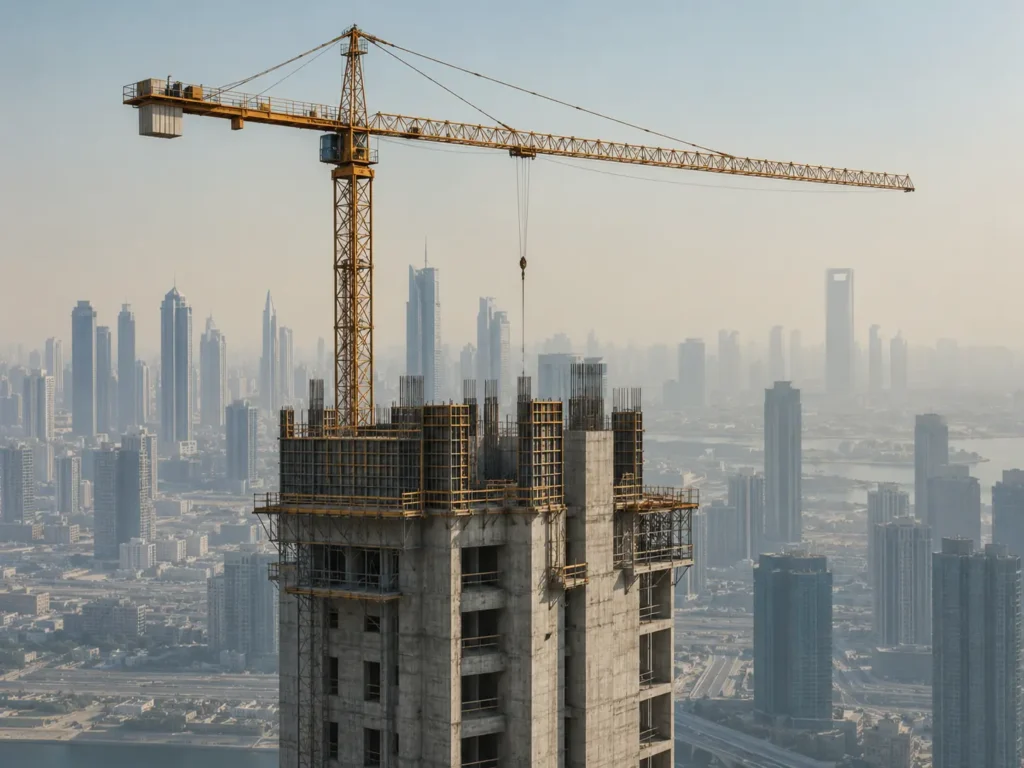
On 9 April 2026, Al Habtoor Group announced an investment exceeding AED 5 billion in a new commercial tower on Sheikh Zayed Road. The ceasefire had been announced two days earlier. Other Dubai developers were shaving prices by up to 10 percent to keep buyers at the table.
That single commitment equals roughly 0.51 percent of Dubai’s entire 2025 GDP, deployed into one building by one family conglomerate at the least certain moment of the year.
What Al Habtoor Group actually announced
The tower will sit within Al Habtoor City, the group’s mixed-use precinct on Sheikh Zayed Road combining hospitality, residential and entertainment assets. Adding dedicated commercial space repositions the cluster as a business destination rather than a lifestyle one.
Khalaf Ahmad Al Habtoor, founding chairman, delivered the announcement by recorded video, citing “our deep confidence in the UAE and in Dubai in particular”. The group described it as the first in a series of developments planned across Dubai and Abu Dhabi.
Why the Al Habtoor Group timing is the message
Read the calendar rather than the press release. Missiles had been intercepted over the city in March. The Strait of Hormuz had closed. Hotel occupancy sat at 33.1 percent.
Al Habtoor said the group was fortunate to “live and invest in a country that enjoys security, stability”. He said it days after that security had faced its most severe test in the emirate’s history.
The Al Habtoor Group contrast nobody is drawing
Here is the part that makes this analytically interesting rather than merely large.
In January 2026, Al Habtoor Group announced it would pursue legal action against the Lebanese government. The group has ranked among Lebanon’s largest foreign investors for decades. It now litigates against the state it backed.
Two jurisdictions, opposite decisions
So the same conglomerate is withdrawing from one country through the courts while committing AED 5 billion to another that had just been attacked.
That comparison isolates what actually drives long-horizon capital. No neighbour bombed Lebanon in 2026. It simply stopped functioning as a legal counterparty. Dubai took physical attack and kept honouring contracts, courts and property rights throughout.
What that says about risk
Investors do not price danger. They price reliability.
A missile is an event with a start and an end. A collapsed legal system is a condition, and conditions do not resolve on a ceasefire timetable. Consequently the Al Habtoor Group decision reads as a judgement about which risk is recoverable and which is not.
Why Al Habtoor Group chose a commercial tower
The asset choice deserves attention, because it has aged well in the five months since.
Dubai office vacancy fell to 6.1 percent by the second quarter of 2026, from 7.7 percent a year earlier. Grade A rents rose 26.2 percent over the same period and Grade B rents 31.5 percent, according to JLL.
The bet was already half-proven
Anyone committing to premium commercial space in April bought into a market where supply was tightening and rents were climbing steeply.
Total Dubai office stock stands near 100.6 million square feet with under 940,000 square feet due before year end, roughly 0.9 percent of existing supply. Therefore new Grade A space entering in the late 2020s meets a shortage that current construction cannot close.
How the Al Habtoor Group bet compares to foreign capital
Al Habtoor Group was not alone in reading the war as sentiment rather than structure, though it moved for different reasons.
Blackstone deployed $250 million into an Abu Dhabi payments platform in late March, before the ceasefire. That was institutional capital treating the shock as temporary, judged from New York against a global opportunity set.
The difference that matters
A family conglomerate operating here for more than five decades is making a different kind of judgement. It cannot diversify away from Dubai, because Dubai is where the business lives.
That constraint cuts both ways. It removes the option of leaving, and it also means the assessment comes from people who watched the emirate absorb 2008, 2015 and 2020 from the inside. The structural case that held through the conflict is the case they have been betting on for fifty years.
What founders should take from the Al Habtoor Group bet
Three lessons transfer beyond property.
Separate event risk from condition risk. Wars, pandemics and market crashes end. Legal unreliability, currency collapse and expropriation do not. Most founders overweight the first category because it produces images, and underweight the second because it produces paperwork.
Announcements are positioning, not information. Committing capital publicly at a fearful moment buys attention no marketing budget could. The tower details, design, timeline and tenant strategy, were not disclosed. The number and the date were the message.
Domicile risk compounds silently. The Lebanon situation took decades to become a lawsuit. Anyone holding assets across multiple jurisdictions should review enforceability rather than returns at least once a year.
There is a fourth point, aimed at anyone smaller. You cannot deploy AED 5 billion, but you can copy the reasoning. Ask which of your commitments would survive a bad quarter and which would survive a bad decade. Most founders have never separated the two, which is why the first shock feels existential when it is usually only expensive.
The counterargument
Confidence statements from developers are marketing, and this one should be read with that in mind.
The group disclosed no construction timeline, no design, no tenant strategy and no financing structure. An AED 5 billion announcement missing all four signals intent rather than a signed contract, and intent can be revised quietly.
There is also a self-interest layer. A developer talking up Dubai during a downturn is protecting the value of everything else it owns here, which does not make the statement false but does explain its timing.
The honest reading
The Al Habtoor Group bet only makes sense if you believe the 2026 conflict damaged sentiment rather than structure.
Five months on, office vacancy is down, rents are up sharply, and the emirate’s legal and regulatory framework operates exactly as it did in February. On the available evidence it is working. The Lebanon comparison running alongside it states plainly what Al Habtoor Group believes actually endangers capital.
Frequently Asked Questions
The group announced an investment exceeding AED 5 billion, roughly $1.36 billion, in a new commercial tower within Al Habtoor City on Sheikh Zayed Road. It described the project as the first in a series planned across Dubai and Abu Dhabi.
The announcement came on 9 April 2026, two days after the US-Iran ceasefire was announced and while other Dubai developers were discounting off-plan prices by up to 10 percent to attract buyers.
The group has been one of Lebanon’s largest foreign investors for decades. In January 2026 it announced it would pursue legal action against the Lebanese government, the latest stage in a long-running dispute.
Office vacancy fell to 6.1 percent by the second quarter of 2026 from 7.7 percent a year earlier, with Grade A rents rising 26.2 percent and Grade B rents 31.5 percent, according to JLL. Supply remains tight.
Sources
Sources: Al Habtoor Group, Al Habtoor Group Reinforces Confidence in Dubai With Landmark AED 5 Billion Investment, April 2026; AGBI, UAE’s Al Habtoor Plans $1.4bn Commercial Tower in Dubai, April 2026; Gulf News, Al Habtoor Group Launches Dh5 Billion Commercial Tower in Dubai, April 2026; GDN Online, Al Habtoor Group Announces $1.36bn New Investment in Dubai Real Estate, April 2026; JLL, UAE Real Estate Market Dynamics Q2 2026, August 2026; Dubai Data and Statistics Establishment, Dubai Economic Survey 2026 preliminary estimates, July 2026. GDP and transaction-share percentages are FOUAE calculations from published figures.
Founders of UAE (FOUAE) is an independent, digital-first business publication covering the founders, companies and economy of the United Arab Emirates. Follow FOUAE on Instagram and LinkedIn.