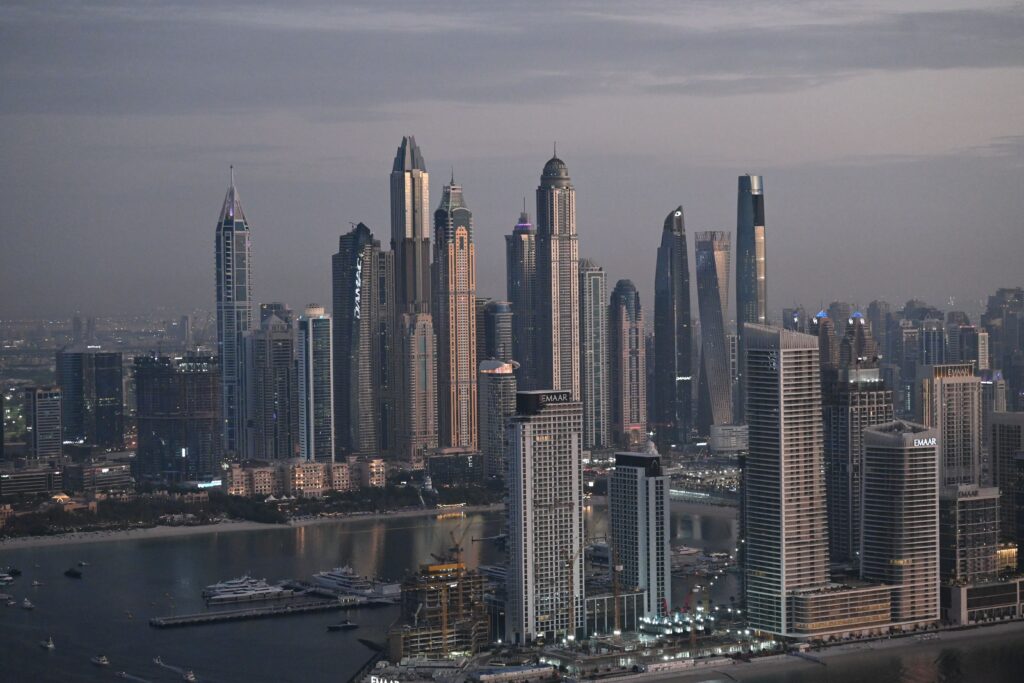
- Did Dubai’s property market actually crash in 2026?
- Two Markets, One Misunderstanding
- What the Transaction Data Shows
- What an Actual Dubai Property Market Crash Looks Like
- Why the Crash Narrative Spread
- What This Means for Investors
- The Verdict on the Dubai Property Market Crash
- Dubai Property Market Crash 2026: Frequently Asked Questions
Did Dubai’s property market actually crash in 2026?
No. The Dubai property market crash reported across social media in March 2026 conflated two different things. Listed developer stocks fell around 21 percent. Physical property prices fell 4 to 7 percent from peak. One is a sentiment index. The other is an asset price.
That distinction is the whole story behind the Dubai property market crash claim. Four months of subsequent data has now settled it.
Two Markets, One Misunderstanding
In short, messages circulating in WhatsApp investment groups through March 2026 carried a consistent claim. Dubai property had crashed 30 to 40 percent. Screenshots of red charts travelled alongside images of smoke over the city. Thousands of investors drew the same alarming conclusion.
Transaction data told a different story about the Dubai property market crash.
What the DFM Real Estate Index actually measures
The Dubai Financial Market Real Estate Index tracks share prices of listed developers. Emaar, Aldar and DAMAC sit inside it. When US and Israeli strikes on Iran began on 28 February 2026, the index fell from roughly 16,700 points to 13,353 by 9 March, a drop of about 21 percent in under two weeks.
That is exactly what equity indices do during geopolitical shocks. Listed shares reprice within seconds because traders and algorithms weigh sentiment and expected future earnings continuously. Emaar Properties fell close to 40 percent from pre-conflict levels, according to Goldman Sachs data reported in March 2026.
Crucially, none of that measures what a two-bedroom apartment in Dubai Marina is worth. It measures how fearful equity investors are about developer earnings over the next twelve months.
Why physical property moves differently
Physical property, by contrast, is a separate market entirely. Prices do not update in real time. They form through individual transactions between a willing buyer and a motivated seller. Site visits, financing and legal process typically take weeks.
So a geopolitical shock compresses transaction volume first. Price follows only partially, and only later. Confusing the two produced the Dubai property market crash narrative. It was a stock market story read as a real estate story.
What the Transaction Data Shows
If a Dubai property market crash had genuinely happened, Dubai Land Department records would show it. They do not.
Q1 2026: a record quarter despite the conflict
January 2026 recorded AED 72.4 billion in residential sales, the highest monthly total in Dubai’s history, according to Dubai Land Department data. That figure predates the conflict.
The full quarter then held. Total transactions reached AED 252 billion across 60,303 deals, up 31 percent in value year on year, according to the Dubai Land Department in April 2026. Foreign investment rose 26 percent to AED 148.35 billion. New investors entering the market grew 14 percent to 29,312.
Volume did slow in March, though. Yet off-plan purchases accounted for roughly 70 percent of transactions throughout the hostilities. Buyers were signing contracts for 2027 and 2028 delivery during active missile interceptions. That is structural confidence rather than panic.
Q2 2026: the real test, and the clearest evidence
Yet the second quarter is where the argument gets settled. Dubai recorded 38,157 sales transactions worth AED 110.2 billion in Q2 2026, according to DXB Interact data compiled in July 2026. Volume fell close to a third against the record Q2 2025. Value fell around 40 percent.
Now look at price. Price per square foot rose 6.5 percent over the same period.
That is the entire thesis in one data point. Volume collapsed. Price did not. Anyone who equated the two was measuring the wrong variable. Property Finder data showed Dubai sales prices up 21.1 percent year on year as of April 2026, at an average of AED 2.21 million, and broadly flat quarter on quarter.
July 2026: where the market stands now
Recovery has since been steady rather than dramatic, however. Dubai recorded 13,930 property sales worth AED 34.88 billion in July 2026, according to Dubai Land Department data analysed by Al Masdar Al Aqaari. Value rose 6.9 percent month on month.
June had already turned by then. It delivered 13,933 sales worth AED 33.2 billion, up 35.5 percent in volume month on month. The same month set a record with 40,022 rental contracts registered, according to fäm Properties.
In total, first-half sales reached AED 286.4 billion across 86,024 transactions. That is the second strongest first half on record, behind only H1 2025.
What an Actual Dubai Property Market Crash Looks Like
The 2008 to 2009 comparison is instructive precisely because that was a genuine Dubai property market crash.
Between late 2008 and 2010, Dubai property values fell more than 50 percent from peak. The correction ran 18 months and deepened through 2009. Specific conditions drove it: developer insolvency, a legal framework that failed to protect off-plan buyers, heavy speculative leverage, real oversupply and the collapse of mortgage financing.
Most of those conditions are simply absent in 2026. Off-plan buyers now hold escrow protection. Roughly 70 percent of transactions are end-user driven. Developer balance sheets are stronger.
However, one 2008 parallel deserves honest attention. Supply is rising, and it matters. Q2 2026 brought Dubai’s highest handover volume in years, alongside a sharp slowdown in new launches. Anyone arguing the market rests on permanent undersupply should treat that shift as a genuine variable, not dismiss it.
Why the Crash Narrative Spread
Availability bias explains most of the Dubai property market crash narrative. People weight recent dramatic events disproportionately. Images of smoke over Dubai and news of market closures created an emotional reality that felt like economic collapse.
Social media then amplified the most alarming figures. That stock index decline travelled widely. Context distinguishing equity markets from property markets did not travel with it.
So a mass inference error followed. The stock market fell sharply, therefore property must have crashed. That reasoning would fail a first-year finance exam. Still, it drove real behaviour. Investors paused site visits and froze transactions, which produced the volume slowdown later cited as proof of the crash.
What This Means for Investors
Three practical conclusions follow for investors reading the Dubai property market crash story.
Separate the index from the asset
First, a listed developer index and a physical asset price measure different things entirely. Investors who conflated them in March 2026 acted on the wrong signal. That mistake is repeatable in any future shock.
Read volume and price as separate variables
Second, Q2 2026 showed that transaction volume can fall by a third while price per square foot rises. Volume measures willingness to transact. Price measures what clears. A pause in one does not imply collapse in the other.
Watch supply, not headlines
Third, the real risk to Dubai pricing is not geopolitical. It is the handover pipeline now arriving. Investors tracking the next twelve months should watch completion volumes and launch activity far more closely than any index chart.
The Verdict on the Dubai Property Market Crash
A 4 to 7 percent correction from a historic peak is not a crash. Founders of UAE has tracked this market through the full episode, and the conclusion has not changed since March.
Dubai’s structural drivers did not, in fact, shift on 28 February 2026. The tax environment, ownership laws, visa architecture and population growth all remained intact through the conflict. They remain intact now.
That said, the honest position is not triumphalism. Volume has genuinely fallen. Supply is genuinely rising. Dubai is transitioning from a momentum cycle to a quality cycle, where selectivity now determines which assets outperform.
The Dubai property market crash existed on WhatsApp. The correction existed in the data. They were never the same size.
Dubai Property Market Crash 2026: Frequently Asked Questions
No. Physical Dubai property prices fell 4 to 7 percent from peak after the February 2026 conflict began. The 21 percent decline widely reported was the Dubai Financial Market Real Estate Index, which tracks listed developer shares rather than property prices. The two measure different things entirely.
The DFM Real Estate Index tracks share prices of listed developers such as Emaar, Aldar and DAMAC. It reprices every second based on investor sentiment about future earnings. Physical property prices form through individual transactions taking weeks to complete. A falling index does not mean falling apartment prices.
Yes. Dubai recorded 13,930 property sales worth AED 34.88 billion in July 2026, with value up 6.9 percent month on month, according to Dubai Land Department data. June had already risen 35.5 percent in volume. First half sales reached AED 286.4 billion, the second strongest on record.
The structural drivers remain intact, including zero property tax, foreign ownership rights and population growth. However, supply is rising sharply, with Q2 2026 delivering Dubai’s highest handover volume in years. Investors should weigh completion pipelines more carefully than geopolitical headlines when assessing the next twelve months.
Sources: Dubai Land Department, Dubai’s real estate transactions surge 31% to reach AED 252 billion in Q1 2026, April 2026; AGBI, Dubai property sales tumble but market settling at true value, July 2026, citing DXB Interact and Dubai Land Department; Al Masdar Al Aqaari, Dubai property sales value rises 6.9% MoM in July 2026, August 2026, citing Dubai Land Department; World Economic Magazine, Record rental activity marks strong month for Dubai real estate, July 2026, citing fäm Properties and DXB Interact; Business Upturn, Iran war impact on Dubai home sales, April 2026, citing REIDIN; Mitchell’s Commercial Realty, Dubai property market crash 2026 correction anatomy, March 2026, citing Goldman Sachs; Property Finder, Dubai residential market update, April 2026; House of Commons Library, Israel/US-Iran conflict 2026, July 2026.