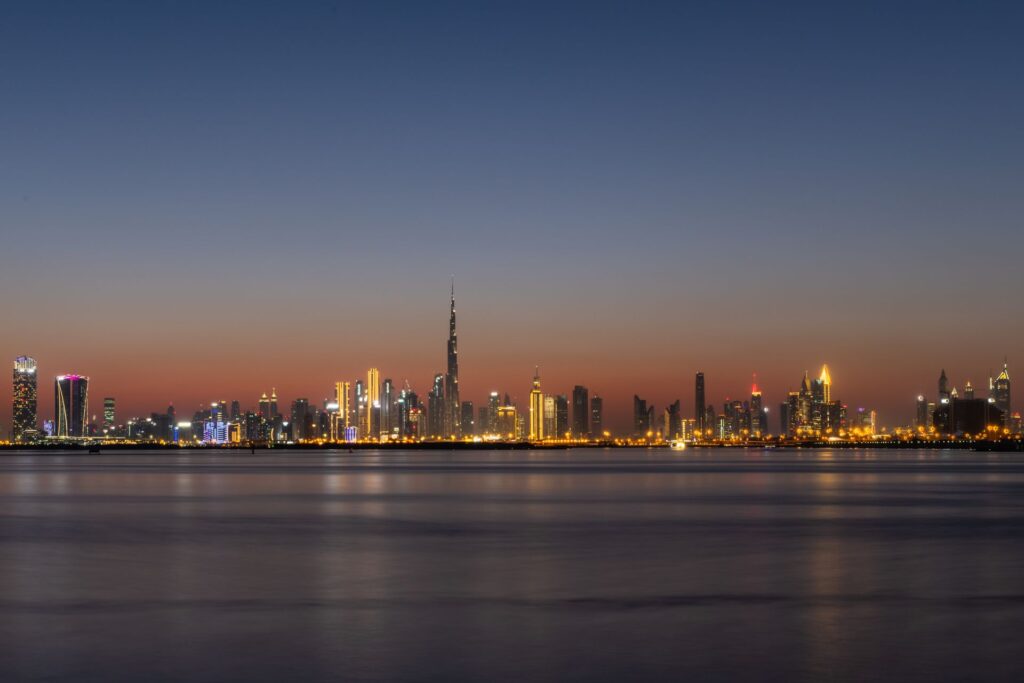
Dubai has put a fresh number on its ambition. In late July 2026, the emirate launched its Economic Survey 2026, and the preliminary estimate at the centre of it is striking: Dubai’s GDP reached AED972 billion, roughly 265 billion dollars, in 2025, up from AED890 billion the year before, while employment climbed to 4.69 million people. It is the kind of figure that gets reported as a milestone and then forgotten by the afternoon. That would be a mistake. Read properly, the number is a progress report on the most audacious economic plan in the region, and it reveals both what is genuinely driving Dubai’s growth and where the risks are hiding.
The headline numbers
Start with what the survey actually shows. Dubai’s GDP at current market prices rose from AED890 billion, about 242 billion dollars, in 2024 to AED972 billion, about 265 billion dollars, in 2025. Employment across the emirate reached 4.69 million people. In real terms, stripping out price effects, the economy grew by roughly 4.4 to 4.5 percent through 2025, and Emirates NBD forecasts a similar pace of around 4.5 percent for 2026.
To put that in global context, the same bank estimates worldwide growth of about 3.1 percent, with advanced economies growing around 1.6 percent. Dubai, in other words, is expanding at close to three times the rate of the developed world, and doing so consistently, with a purchasing managers’ index reading in late 2025 at its strongest in months. This is not a one-off spike. It is sustained, above-trend growth in a year that included a regional war.
What is actually driving it
The instinctive assumption about a Gulf economy is oil, and for Dubai that assumption is simply wrong. Oil accounts for only around one percent of Dubai’s GDP. The growth is coming from a genuinely diversified base, and that diversification is the single most important thing the number reveals.
The engine is spread across sectors. Wholesale and retail trade, the beating heart of Dubai’s role as a global re-export and commerce hub, is the largest contributor at roughly a quarter of GDP. Transport and logistics add over a tenth, financial services a similar share, and real estate remains a cornerstone, growing strongly and drawing continued foreign investment. The information and communications sector, the visitor economy with more than 15 million tourists in the first ten months of 2025, and a fast-rising healthcare sector that has been among the quickest-growing of all, round out a broad and deepening base.
The significance of that spread is resilience. An economy that leans on one sector rises and falls with it. An economy where trade, finance, real estate, logistics, tourism, technology and healthcare all pull together has no single point of failure, which is precisely why Dubai was able to post above-trend growth through a year of regional conflict. The diversification is not an accident. It is the deliberate result of a decades-long strategy, and the 265 billion dollar figure is the evidence that the strategy is working.
The plan behind the number
That strategy now has an explicit name and a hard target. The Dubai Economic Agenda, known as D33 and launched in January 2023, sets out to double the size of Dubai’s economy within a decade and to place the city among the world’s top three urban economies. Its headline targets for 2033 are enormous: to lift foreign trade in goods and services to AED25.6 trillion, to raise cumulative foreign direct investment to AED650 billion, to grow private-sector investment to AED1 trillion, and to expand government expenditure to AED700 billion.
Seen against that plan, the 2025 GDP figure is not a standalone milestone. It is a checkpoint on the doubling journey. Doubling an economy in ten years demands sustained, compounding growth, and the current pace, combined with the diversification underneath it, suggests Dubai is broadly tracking toward the goal rather than drifting away from it. The number matters less as an absolute than as a marker on a trajectory the government has publicly committed to and is being measured against.
The talent-and-capital engine
There is a second story inside the employment figure. Reaching 4.69 million jobs in a city whose population is heading toward and past the four-million mark tells you how Dubai actually grows: by importing people and companies at scale. Growth here is powered as much by attracting talent and capital as by any productivity gain within existing firms.
The mechanisms are deliberate. Golden and green visas attract and retain a stable pool of high-skilled global talent. The Next Gen FDI initiative targets foreign investment in future-facing sectors. And the results show up in the corporate migration data: in the first half of 2025, Dubai attracted 31 multinational companies, a 138 percent increase on the same period a year earlier. The emirate is running a machine that pulls in people who need housing, services and schools, and companies that need offices, staff and suppliers, each new arrival generating demand that feeds the next cycle of growth. The 265 billion dollar economy is, in large part, the output of that machine.
What it means for founders
For a founder, a diversified 265 billion dollar economy growing at 4.5 percent, with a public commitment to double, is a rising tide, and the practical question is how to position within it.
The clearest opportunities sit in the sectors the data shows are growing fastest and where the government most wants private capital to flow. Healthcare has been among the quickest-expanding sectors and connects to the wider regional push into health as an industry. Financial services, technology and the visitor economy are all scaling. And the D33 targets themselves are a map of intent: a goal of AED1 trillion in private-sector investment is an explicit signal of where the state wants private founders and financiers to build. Aligning a business with the D33 priority sectors is, in effect, positioning it in the path of deliberately engineered demand.
The talent-and-capital inflow is its own opportunity. Every wave of new residents and companies needs services, from housing and education to financial products, logistics and technology. Businesses that serve the influx, rather than competing only for the existing base, are riding the actual source of the growth.
The honest caveats
A disciplined reading has to include the qualifications, because a headline number can flatter. The first is the distinction between nominal and real. The 265 billion dollar figure is measured at current prices, and part of the jump from the previous year reflects price increases rather than pure additional output. The real growth rate, around 4.5 percent, is strong and well above the developed-world average, but it is not the explosive number the headline might suggest, and it is honest to hold both figures in view.
The second is that the doubling target is genuinely ambitious. Base effects make it progressively harder to sustain high percentage growth as the economy gets larger, and hitting the D33 goal will require the pace to hold or accelerate over the remaining years, which is not guaranteed.
The third is concentration and exposure. Real estate remains a cornerstone, which ties a meaningful part of the economy to a market with its own cycles and a large wave of incoming supply. The 2026 regional conflict was a reminder that Dubai’s growth, however diversified, remains exposed to geopolitics it does not control. And the model depends on continued inflows of people and capital, which are strong now but are not laws of nature.
Finally, growth this fast has costs. It strains infrastructure, pushes up housing and living costs, and intensifies the competition for talent that employers already feel acutely. Success is not free, and the frictions of rapid expansion are real.
The takeaway
The 265 billion dollar figure is a scorecard, and on balance it says Dubai’s long bet on diversification is paying off. The economy is bigger, its base is broader, and it is still growing at nearly three times the pace of the developed world, even after a year that tested it. But a number is a snapshot, and the more important story is the trajectory behind it. Dubai has publicly committed to doubling itself within a decade, has told the world exactly how large it intends to become and through which sectors, and is, so far, roughly on pace.
For founders, the lesson is not the number itself. It is the direction and the deliberate engineering behind it. Very few economies announce, in specific and measurable terms, exactly where they are going and how big they intend to be. Dubai has, and it is publishing the scorecard each year to prove it. The opportunity lies in being positioned along that path before the economy doubles, not after everyone else has noticed that it did.
Sources: Arabian Business, Dubai Launches Economic Survey 2026 as GDP Climbs to $265bn and Employment Reaches 4.69m, July 2026, citing the Dubai Data and Statistics Establishment; Gulf News, Dubai Economy Seen Growing 4.5% in 2026, citing Emirates NBD; Digital Dubai and Dubai Public Debt Management Office, Dubai GDP releases for Q1, Q2 and the first nine months of 2025; Business Recorder, Dubai’s GDP Growth the Result of a Multifaceted Economic Strategy; Dubai Economic Agenda D33 official targets via dubai.ae.