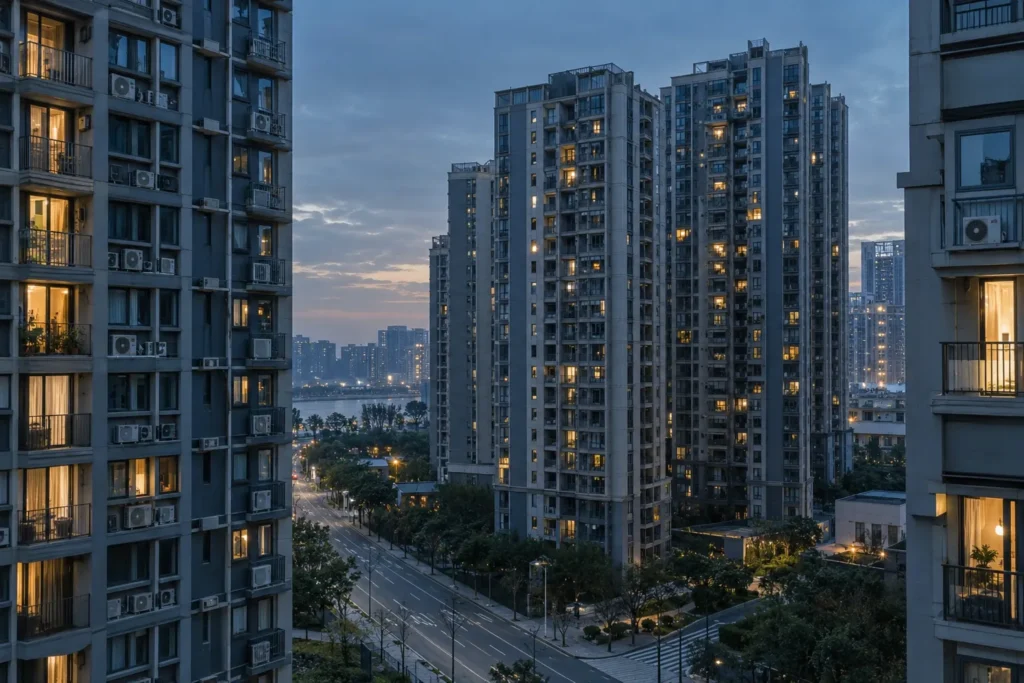
A record wave of new homes is about to hit Dubai, and depending on who you ask, it is either the glut that finally breaks the market or the moment the market proves it has grown up. Both cannot be true. For the many people whose wealth is concentrated in Dubai property, this is not an abstract debate, and the disciplined way to approach it is to separate the fear of a crash from the evidence of a plateau. Do that, and the data points fairly clearly toward one answer.
The scale of the wave
The numbers are genuinely large. Between 200,000 and 300,000 new residential units are scheduled to enter the Dubai market by 2028, with the peak of handovers concentrated in 2026 and 2027. Fitch estimates nearly 250,000 units arriving over 2025 to 2027, with as many as 120,000 set to hand over in 2026 alone. Moody’s puts the 2025 to 2027 figure at more than 150,000 homes, equal to roughly 20 percent of Dubai’s existing housing stock. One industry study projects around 70,000 deliveries in 2027, nearly double the five-year average and the highest single-year supply the city has seen in over a decade. The volume is concentrated in specific corridors, notably Jumeirah Village Circle, Business Bay, Azizi Venice, Damac Lagoons and Arjan.
On the surface, that looks like the setup for a glut. But the surface is misleading.
The caveat that changes everything: launches versus handovers
Here is the fact that most alarmist coverage skips. Dubai’s actual handovers consistently fall well short of forecast. In 2025, only around 62 percent of the forecast units were expected to complete. For 2026, the tracking figure is closer to 48 percent. Funding delays, contractor shortages and buyer payment schedules stretch delivery, so the pipeline that looks terrifying on paper arrives more slowly and more unevenly than the headline numbers imply. That chronic under-delivery is the market’s first and most underrated shock absorber. The glut does not arrive all at once.
The demand doing the absorbing
The second absorber is demand, and it is not soft. Dubai recorded more than 202,000 residential sales transactions in 2025, a figure over four times the level of 2021. The population is projected to pass 3.9 million by 2028, fed by Golden Visa and long-term residency reforms, continued high-net-worth migration, and strong non-oil economic growth. Rental yields remain in the region of 6 to 8 percent, among the best of any major global city, which keeps investor demand alive. Crucially, end-user demand has risen materially since 2021, reducing the market’s old reliance on speculative flipping. This is real, structural demand, and it is what will absorb most of the incoming supply.
The real answer is segmentation, not direction
Put the two sides together and the honest conclusion emerges. This is not a story of citywide oversupply. It is a story of segmentation.
The vulnerable zone is mid-market apartments in heavily supplied corridors where demand has been investor-driven and speculative. In places like Jumeirah Village Circle and the outer communities, where thousands of similar units are completing at once, a moderate correction of perhaps 10 to 15 percent is plausible, along with softer rents and longer absorption times.
The resilient zone is prime and low-density housing. Villa and townhouse communities, and established central districts like Downtown, Palm Jumeirah and Dubai Marina, are cushioned by limited land and genuine end-user demand. Villa values have risen more than 200 percent since the pandemic precisely because supply there cannot easily expand. So the question “will Dubai property fall?” is the wrong one. The right question is “which segment, and which location?”
What the agencies actually say
This is roughly where the serious analysts land. Fitch warns of a correction of up to 15 percent, concentrated in oversupplied segments. Moody’s expects a rebalancing rather than a collapse. The consensus view is explicit that this is not a repeat of 2009: the government now has stabilising regulations, the buyer base is far more weighted toward end-users, and the market carries less speculative leverage than it did before the last crash. What is coming is a moderate, segment-specific correction and a shift from relentless price growth into a calmer, rebalancing phase, with 2027 as the genuine test year when the supply spike peaks.
Coming of age, not falling down
Step back and the deeper reading becomes clear. A market that can absorb new supply equal to a fifth of its entire stock over three years without collapsing is not a fragile one. What looks, from inside the noise, like the end of a boom is better understood as the market maturing. Dubai is transitioning from a speculative, everything-rises phase into a segmented, end-user-anchored one, where location, build quality and real demand matter more than a rising tide that lifts everything. That is a healthier market, not a weaker one, even if it is a less forgiving one for the careless buyer.
What it means for you
For anyone holding or buying Dubai property, the era of purchasing almost anything and flipping it before handover is closing. The disciplined approach now is to favour prime and low-density communities, to prioritise yield and the depth of genuine end-user demand over headline price momentum, and to avoid the oversupplied corridors and the 12 to 24 month flip strategies that worked in 2021 but carry real risk today. Stress-test any purchase against a 10 to 15 percent price drop, and think in five to fifteen year horizons aligned with the D33 and Dubai 2040 plans rather than in quick exits. The right posture is precision, not panic.
The verdict
So, correction or coming of age? The honest answer is both, and that is exactly the point. Certain over-built, speculation-heavy pockets will correct, and that correction is healthy rather than alarming. The broader market is not crashing. It is growing up, moving from a phase where everything rose together into one where the specific asset, its location and its quality determine the outcome.
For anyone whose wealth is concentrated in Dubai property, the useful question is therefore no longer whether the market will keep rising, because as a single block it will not move as one again. The question is whether the specific assets you hold sit on the resilient side of a market that has finally stopped behaving like a single, rising trade. Answer that honestly, and the supply wave becomes something to navigate rather than something to fear.
Sources: Fitch Ratings and Moody’s supply and correction forecasts via Khaleej Times and Reuters, 2025 to 2026; Betterhomes, Will Dubai Property Prices Rise or Fall in 2026; Engel & Voelkers Dubai Housing Market report, January 2026; Morgan’s International Realty and Totality Real Estate supply and delivery studies, 2025 to 2028; Knight Frank, Property Finder and Cavendish Maxwell pipeline estimates; Dubai Land Department 2025 transaction data; Arabian Post and LYM Real Estate market-cycle analysis, 2026.