How the Son of a Dhow Captain Built the Burj Khalifa, Then Gave Away Its Name
On the evening of January 4, 2010, a wall of fireworks lit up the sky over Downtown Dubai. Ten thousand pyrotechnics shot off the tower in choreographed sequence with the Dubai Fountain. Thousands of residents stood on the promenade, looking up at the world’s tallest building.
And then came the announcement nobody outside a small circle had been expecting.
The tower, known throughout its thirteen years of planning and construction as the Burj Dubai, would be renamed. From that moment on, the world would call it the Burj Khalifa, in honour of Sheikh Khalifa bin Zayed Al Nahyan, President of the UAE.
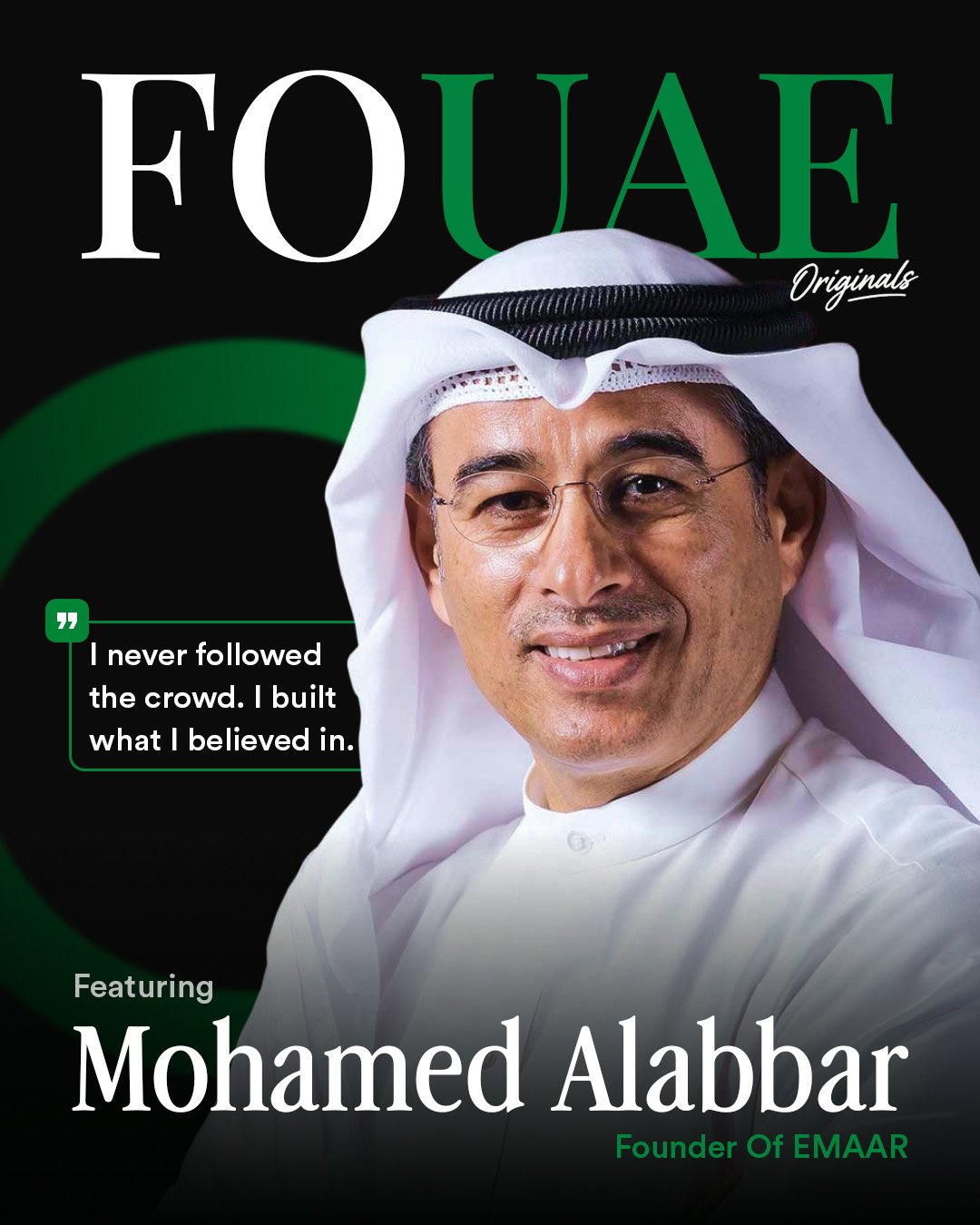
The man who had spent more than a decade building it stood and watched. Mohamed Alabbar didn’t protest. He had a company to protect. And he had figured out something most builders never do. A name is rented. The empire is owned.
Today, most people still believe the Burj Khalifa belongs to the Al Nahyan family of Abu Dhabi. It doesn’t. It belongs to Emaar Properties, a publicly listed company on the Dubai Financial Market. And the man who founded Emaar grew up as the eldest of 12 children in a modest neighbourhood of Dubai called Rashidiya. His father was a dhow captain.
From Rashidiya to Seattle
In the 1960s, Rashidiya was not the Dubai of glass towers and eight-lane highways. It was a working district by the creek, defined by the rhythm of trade across the Gulf. Alabbar’s father captained a traditional dhow, the kind of wooden trading vessel that had carried goods between the Arabian Peninsula, Persia, and East Africa for centuries.
He raised twelve children on the disciplines of the sea: punctuality, hard work, the weight of being responsible for cargo that wasn’t yours. The Burj Khalifa was, in some sense, built by a man whose first lessons in management came from a wooden boat.
In the 1970s, the newly federated UAE began sending bright students abroad on government scholarships. Alabbar won one. He flew to Seattle, studied finance and business administration, and graduated in 1981. Then he came home to a city that had just begun to dream bigger than itself.
The Government Man
His first role was at the Central Bank of the UAE in Abu Dhabi. From there, he was sent to Singapore as director of Al Khaleej Investments. Singapore in the late 1980s was a masterclass in what a small, ambitious city-state could become. Alabbar took notes.
In 1992, Sheikh Mohammed bin Rashid Al Maktoum called him back to Dubai to establish the Department of Economic Development. As founding Director General, his job was to make Dubai open for business. Attract foreign capital. Simplify bureaucracy. Turn the emirate into an investment magnet. He helped launch the Dubai Shopping Festival in 1996, which drew over two million visitors in its first year.
His salary, by his own admission, was small. “Around DH22,000. But to me it was not work.”
He wasn’t doing a job. He was building a city.
1997: The Year Emaar Was Born
On 16 June 1997, Mohamed Alabbar founded Emaar Properties.
The popular version of this story is that he walked out of government and started Emaar from scratch. The truer version is more interesting. Emaar was a Dubai-government-backed venture from day one, with the government holding the majority stake at inception. What Alabbar brought wasn’t capital. It was conviction.
His conviction was this: oil was a finite asset for Dubai, and the future would have to be built on real estate, tourism, and trade. To pull in global capital, Dubai needed a global skyline. And to build one, the city needed a developer willing to bet bigger than anyone in the region had bet before.
Emaar’s first major project was Dubai Marina. When the team started selling apartments off-plan, all 288 units of the Murjan Tower sold out. Buyers were paying for apartments in buildings that did not yet exist, in a city most of the world had not yet heard of. It was a referendum on Alabbar’s credibility. He passed it.
The “Stupidest Idea” That Built Emaar
In 2000, Emaar went public on the Dubai Financial Market, the first property company in the region to offer shares to foreign nationals. Capital flowed in. Downtown Dubai began.
A quarter of a century later, on stage at Dubai’s 1 Billion Followers Summit, Alabbar was asked about the worst decision of his career.
“The stupidest idea we ever did was to go public.”
The room laughed. He wasn’t joking.
He went on: “It feels I have to strip naked in front of the public where they can see my weight, how much I’ve eaten, how much I spend.” Then the reframe: “But the good thing? It differentiates between the men and the boys.”
This is the Alabbar paradox. The decision he calls his stupidest is the same one that built Emaar’s discipline. Every ninety days, the company had to defend its numbers in public. By the time the worst storm of his career arrived, Emaar had been doing this for eight years.
2008: The Storm
In the autumn of 2008, Lehman Brothers collapsed and the global credit system seized up. Dubai, more than almost any city on earth, had built its boom on cheap foreign capital. The boom became a bust.
At that exact moment, Emaar was managing approximately 100 active construction sites and 40,000 customers paying monthly instalments on off-plan properties. In a normal year, about 1,000 customers at any time would request a short payment delay. At the peak of what Alabbar calls the “tsunami,” the number climbed.
It climbed to 1,200.
That was it. Out of 40,000 customers, in the worst financial year of a generation, the delinquent-by-request number barely moved. Then it fell back to 700.
That statistic, Alabbar has said, is the one he is proudest of. Not the height of the Burj. Not the size of the Mall. The fact that 38,800 people kept paying, on time, for apartments that hadn’t been built yet, during the worst crisis in modern memory.
But the storm wasn’t only inside Emaar’s books. As Dubai’s debt crisis deepened, the emirate had to turn to its oil-rich neighbour. Abu Dhabi provided over $15 billion in bailout funds. Among the projects whose future hung in the balance was the tower still rising in Downtown Dubai.
The Gift of a Name
Which brings us back to January 4, 2010. The moment the world’s tallest building stopped being the Burj Dubai and became the Burj Khalifa.
It was a calculated act of gratitude. It was also a quiet act of survival. The asset stayed in Emaar’s hands. The name went to the man who had helped save Dubai’s balance sheet.
Most people still confuse the two. They assume that because the building is called Burj Khalifa, it must belong to royalty. It doesn’t. Emaar Properties owns and operates the 828-metre tower, the Dubai Mall, the Dubai Fountain, and the entire Downtown Dubai district.
Alabbar gave up the name. He kept the empire.
What the Builders Know
The Burj wasn’t the end of Alabbar’s story. It was the punctuation mark in the middle. He went on to launch Eagle Hills, Noon (the e-commerce platform now competing with Amazon across the region), Zand (the UAE’s first fully digital bank), and he chairs Americana Group. By the end of 2025, Emaar carried a market valuation north of $124 billion.
The temptation, when you read a story like this, is to squeeze it into a clean lesson. Hard work pays off. Believe in your vision.
The deeper lesson is harder to fit on a slide.
The biggest builders aren’t the ones who avoid the crash. There is no avoiding 2008 if you are a developer with 100 active sites. The biggest builders are the ones who spent the previous decade building the institutional discipline that lets them survive without dismantling the asset.
Alabbar’s “stupidest idea,” taking Emaar public in 2000, was the same decision that saved him in 2008. And when the moment came to give up something, a name, a piece of ego, the very brand of his greatest creation, he gave it up without flinching. Because somewhere along the way, he had figured out what was the asset and what was just the sticker on the asset.
Today, Emaar still owns the building most people think belongs to a king.
Mohamed Alabbar built well.