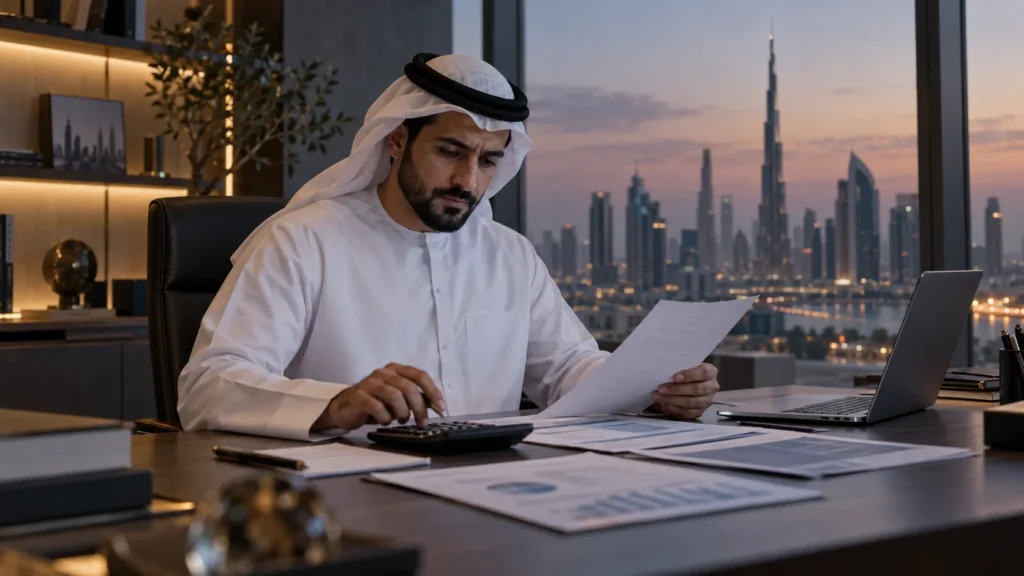
Most people look at a trade show and see a few days of booths, lanyards and business cards. Dubai looks at the same thing and sees an industry. In 2025, the large-scale events hosted at a single venue, the Dubai World Trade Centre, generated a record AED 25.03 billion, close to 7 billion dollars, in economic output for the city. That figure is not a rounding error in the tourism accounts. It is the output of a deliberately engineered growth engine, one that most founders walk straight past without realising it is one of the most powerful business-development tools in the entire region.
Understanding how that machine works, and how to use it rather than merely attend it, is worth far more than the price of a GITEX ticket.
The scale most people miss
Start with the numbers, because they reframe the whole conversation. In 2025, the Dubai World Trade Centre’s large-scale business events delivered a record AED 25.03 billion in total economic output, a 12 percent increase on the year before. They contributed AED 14.66 billion in gross value added directly to Dubai’s GDP, the highest annual figure the venue has ever recorded. This came from 108 major exhibitions, conventions and conferences, which together drew nearly 2.18 million attendees, including around 947,000 from overseas. Across its entire calendar, the venue welcomed close to 3 million participants in the year.
The employment effect is just as striking. That activity supported more than 94,000 jobs across the events ecosystem and adjacent sectors, a 10 percent rise on the previous year, and those jobs generated over AED 4.7 billion in household income. The single most revealing statistic, though, is the multiplier. According to the venue’s economic impact assessment, every one dirham spent at one of its events generated 5.5 dirhams in total economic output across the city. That is the number that explains why the government treats events not as a hospitality nicety but as strategic infrastructure.
Why an event is not tourism
The instinct is to file all of this under tourism, but that misreads the mechanism, and the mechanism is the point. A business event is not valuable because of the ticket revenue or the stand fees. It is valuable because it acts as an anchor that pulls high-spending international visitors into the city, who then spend across the entire economy while they are there.
The breakdown of that spending makes it concrete. Direct spending linked to the venue’s 2025 events reached AED 13.48 billion, of which accommodation accounted for AED 3.79 billion, travel and transport for AED 2.98 billion, retail for AED 2.55 billion, restaurants and food and beverage for AED 2.1 billion, and business entertainment for AED 1.81 billion. In other words, the exhibition hall is the hook, and the hotels, restaurants, taxis, malls and airlines are where much of the real money lands. An international attendee spent, on average, over AED 9,900 per event, almost seven times what a local attendee spent, and stayed an average of 5.6 days, often bringing companions. The event is a machine for importing affluent, time-limited demand and distributing it across the whole city.
That is a fundamentally different economic object from a tourist on a beach holiday. It is closer to a port or an airport: a piece of infrastructure whose entire purpose is to move high-value flows through the local economy. Which is exactly how Dubai has learned to treat it.
The flagship engine
If the events sector is a machine, GITEX Global is its headline engine. Now more than four decades old, it has grown from a modest IT showcase into one of the largest technology and startup gatherings on the planet. The 2026 edition, running from 7 to 11 December, expects to bring together more than 200,000 attendees from over 180 countries, around 6,800 exhibiting companies, and more than 400 government entities.
Two changes to the 2026 edition signal how seriously Dubai takes this. First, GITEX is moving, for the first time in its history, out of the Dubai World Trade Centre and into the Dubai Exhibition Centre at Expo City, a venue undergoing a 2.7 billion dollar expansion to become the largest purpose-built indoor events space in the region. Second, it has shifted from its long-standing October slot to December, placing it in the middle of Dubai’s peak season so that international visitors can combine the business trip with the city’s lifestyle at its best. The startup-focused sister event, Expand North Star, is co-located under the same roof, and a dedicated GITEX Scale Summit opens the week for senior leaders. For five days, founders, investors, enterprise buyers and government decision-makers are all in one place at once.
GITEX is not alone. The healthcare and medical sector, anchored by the event now known as the World Health Expo, was the single largest contributor in 2025, drawing more than 434,000 attendees and generating AED 3.73 billion in gross value added. Food and beverage, led by Gulfood, contributed AED 2.38 billion, and the ICT sector around GITEX added close to AED 2 billion. Together, just these three sectors accounted for more than half of the venue’s total economic contribution. Dubai has, in effect, built a portfolio of global anchor events across the industries it most wants to grow.
The strategy behind the machine
None of this is accidental, and the ambition is explicit. The events sector is a named pillar of the Dubai Economic Agenda, the D33 plan to double the size of the city’s economy by 2033. The venue’s leadership has stated a goal to double its event portfolio and triple its economic contribution, and the multibillion-dirham expansion of the Expo City venue is the physical bet backing that promise. Dubai is not hoping the events industry grows. It is building the capacity to force it to.
Honesty requires naming the competition, because the UAE no longer holds this space uncontested. Saudi Arabia’s LEAP has, in only a few years, become one of the largest technology events in the world, and Riyadh is competing aggressively for the same delegates, exhibitors and conventions that Dubai has long attracted. This is the same regional rivalry playing out across finance and headquarters, now extended to the business-events arena. Dubai’s advantages remain formidable: a four-decade track record, unmatched global connectivity, visa-free or visa-on-arrival access for most nationalities, and a lifestyle wrap that few competitors can match. But the competition is real, and it is precisely why Dubai keeps pouring capital into bigger and better venues rather than resting on its lead.
What this means for founders
Here is where the machine becomes personal, and where most founders leave value on the table. The events calendar is not just an economic statistic for the government to celebrate. It is a compressed business-development engine, and using it well can collapse a year of market entry into a single week.
Consider what a founder would otherwise have to do to reach the audience that GITEX assembles: fly to multiple countries, chase introductions to enterprise buyers, court government procurement teams, and pitch investors across different time zones over many months. GITEX, and its startup arm Expand North Star, put all of those people in a few square kilometres for five days. For a founder with a clear product and a clear goal, that is one of the highest-leverage business-development opportunities available anywhere in the region.
The practical plays follow from that. Exhibit strategically rather than just showing up, with a sharp demo and a specific pipeline target rather than a vague hope of visibility. Use the calendar to compress a market entry, booking meetings with prospective partners, buyers and investors in advance so the days are spent closing rather than wandering. Time a launch or a fundraise around the events window, when the decision-makers you need are actually in the city and in the mood to do business. And treat the peak-season timing as the feature it is designed to be, because the people you want to meet are present, not distracted or away.
The honest caveat is the one the numbers hide. Events are expensive and noisy, and showing up without a plan is one of the fastest ways to waste money in Dubai. The return does not come from the badge or the booth. It comes from the preparation: the pre-booked meetings, the rehearsed demo, the follow-up discipline in the weeks after the doors close. The founders who win at GITEX are almost always the ones who did the real work before it started. The quiet season before the event is where the advantage is actually built.
The takeaway
Dubai has done to business events what it once did to ports and to finance. It took a service that most cities treat as a sideline and turned it into strategic infrastructure and a genuine industry in its own right, worth nearly 7 billion dollars a year in output and tens of thousands of jobs. For the city, the machine is a device for importing high-value global demand and distributing it across hotels, restaurants, retail and beyond. For a founder, it is something rarer: a once-a-year compression of the region’s entire business network into a single place and a single week.
The machine is running, and it is getting bigger. The only real question is whether you turn up to it as a tourist, wandering the halls and collecting brochures, or as an operator, arriving with a plan to convert five days into a year’s worth of pipeline. In a city that engineered the whole thing on purpose, showing up unprepared is the one genuinely expensive mistake.
Sources: Dubai World Trade Centre 2025 Economic Impact Assessment via Khaleej Times, Gulf News, Zawya and the UAE Government Media Office, June 2026; Gulf Today, DWTC Welcomes Nearly 3 Million Participants in 2025, April 2026; GITEX Global 2026 official pages via Dubai Exhibition Centre and gitex.com; Dubai Economic Agenda D33 statements; Arabian Business, DWTC H1 2025 Events Lineup.