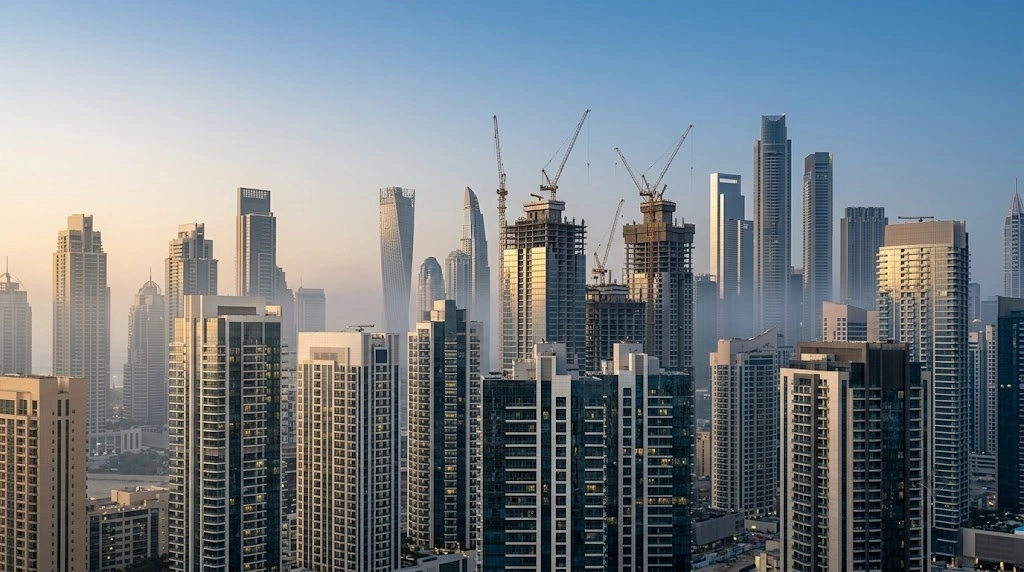
For five years, the story of UAE real estate was a story of launches. Record off-plan sales, towers that sold out in hours, prices that only ever seemed to climb. It was a market defined by the beginning of projects, by the glossy renders and the launch-day queues. In 2026, that story quietly changed. The market has entered a phase that is far less glamorous and far more revealing: delivery. With around 131 billion dollars of construction underway and up to 120,000 homes slated for completion this year, the question is no longer whether people will buy. It is whether developers can actually build, hand over, and have the market absorb it all. That is a much harder test, and it is the one that will define the next eighteen months.
The shift from launches to handovers
The first half of 2026 marked a genuine turning point. As one industry consultancy put it, the UAE construction market is no longer defined simply by growth. It is entering a more mature phase in which the ability to deliver projects efficiently, sustainably and at scale has become just as important as launching them. The language across the sector has changed accordingly. Developers are talking less about new project announcements and more about completion, quality and handover timelines.
The scale of what has to be delivered is substantial. Construction output across the country is running at around 131 billion dollars, fuelled by the residential and hospitality pipelines. In the second half of 2026 alone, roughly 40,000 residential units are scheduled for completion, split between Dubai at around 28,300 and Abu Dhabi at around 11,700. For the full year, developers have slated anywhere from 90,000 to over 120,000 units on paper. Dubai had already handed over some 44,000 homes between the start of the year and mid-2026. Individual developers illustrate the momentum: Sobha Realty is delivering nearly 6,819 units this year worth over 21 billion dirhams, its largest annual delivery to date, while DAMAC has announced 8,800 handovers alongside more than 10 billion dirhams of construction contracts awarded in the first half. The long-promised supply wave is no longer a forecast. It is arriving.
Demand is not the problem
Here is the reassuring part, and it is important to state clearly because it separates this moment from a genuine downturn. Demand has not collapsed. Quite the opposite. Despite the regional conflict that erupted in late February 2026, the UAE property market posted a record-breaking first quarter, with Dubai registering around 252 billion dirhams in transactions, a 31 percent year-on-year increase. Building permits in Dubai rose 12 percent to 10,776 in the first quarter, a sign that developers are still confident enough to keep initiating projects. Off-plan sales continued to dominate activity.
So this is not a story of buyers disappearing. It is a story of a market transitioning, in the words of the sector itself, toward a mature, absorption-led phase. The demand is real and continuing. The test has simply moved from the sales office to the construction site.
The real test is delivery capacity
This is the crux of the matter, and it is where the execution phase will be won or lost. The challenge for the rest of 2026 is not selling. It is capacity. As more and more projects move forward at the same time, pressure builds on the people and systems that actually have to deliver them: consultants, contractors, engineers and the supply chains that feed them. As one consultancy chief executive put it plainly, a strong pipeline only creates value when the market has the technical and operational capacity to deliver it.
When an entire industry tries to build at once, predictable frictions appear. Contractor and consultant capacity gets stretched. Skilled labour becomes scarcer and more expensive. Material and equipment supply chains tighten. Timelines slip, costs inflate, and in the worst cases, quality suffers. This is precisely why the sector is now emphasising early planning, realistic timelines, disciplined procurement, coordinated teams and well-defined project scopes. Projects that begin with those foundations are far better positioned to progress efficiently than those that do not.
There is a paradox buried in this that seasoned observers understand well. UAE developers have historically delivered fewer units than their forecasts promised, because of exactly these delivery frictions. That completion gap is frustrating for buyers waiting on a home, but at the market level it acts as a natural shock absorber, spreading the supply wave out over time rather than dumping it all at once. The delivery phase, in other words, is both the market’s biggest operational challenge and, through its own inefficiency, one of its defences against a glut.
The recalibration in prices and rents
As supply comes online and demand cools slightly from its recent highs, the market is recalibrating, and this is healthy rather than alarming. According to JLL, both sales prices and rental rates showed simultaneous moderation in the second quarter of 2026 after a period of high growth, a softening the firm attributed to cooling demand, increasing supply and the uncertainty tied to the regional conflict earlier in the year.
Critically, government policy is actively cushioning the transition rather than leaving it to run hot or cold. The second quarter saw a pivotal shift toward targeted intervention, including a rental freeze in Abu Dhabi designed to protect affordability and retain occupiers, which the market read as a signal of a broader long-term commitment to stability. Developers, for their part, are responding rationally: exercising greater caution on new launches, redirecting focus toward completing existing projects and maintaining quality, and competing through differentiation, increasingly by partnering with prestigious international brands to command premium positioning. This is a market being managed toward a soft landing, not one left to crash.
What it means for investors and founders
For investors, the era of buying almost anything off-plan and flipping it before completion is fading, and the market is rewarding a different set of skills. Delivery risk has become a central diligence factor. In a market where tens of thousands of units are completing at once and capacity is stretched, the track record of the developer matters enormously. Buying from developers with a proven history of handing over on time and to standard is now a core part of protecting an investment. Moderating prices and rents mean better entry points for genuine end-users and long-term holders, but they also mean the speculative gains of recent years are unlikely to repeat, so the strategy shifts from quick appreciation toward yield, quality and location.
For founders, the execution phase is a genuine opportunity, because it creates demand for anything that helps developers deliver at scale. Construction technology is already scaling fast, with a large and rapidly growing share of construction businesses adopting AI and machine learning, and the pressure of the delivery phase only accelerates that. Project management software, procurement and supply-chain platforms, proptech, quality and compliance tools, and the services that help developers plan realistically and build efficiently all sit in the path of a market that has suddenly made execution its priority. The broader runway is intact too, with the UAE real estate market projected to reach around 759 billion dollars by 2029. The demand for delivery excellence is structural, not temporary.
The honest caveats
A clear-eyed account has to name the risks. Delivery strain could still produce delays, cost overruns and quality problems in specific projects, particularly among less experienced developers stretching to build during a capacity crunch. The moderation in prices and rents, while healthy, means the exceptional returns of the recent past will not return, and some investors who bought at the peak on speculative assumptions may be disappointed. Certain segments, particularly mid-market apartments in heavily supplied corridors, carry real oversupply risk if absorption lags delivery. And the market remains exposed to a geopolitical environment it does not control, as the early-2026 conflict demonstrated. The fundamentals of demand, population growth and policy support are cushioning the transition, but they are cushioning a genuine test, not eliminating it.
The takeaway
The launch phase was the easy part. Announce a tower, sell it off-plan, watch the price rise, repeat. The delivery phase is where a maturing market proves itself, and the question it poses is unforgiving: can the UAE actually build the enormous pipeline it has sold, hand it over with quality, and absorb it without tipping into a glut? So far, the evidence points to a controlled recalibration rather than a crash. Demand is strong, prices are cooling gently, the government is cushioning the landing, and developers are focused on execution.
But the next eighteen months, as tens of thousands of units complete, are when the market will actually prove whether its vast pipeline was a promise kept or a problem deferred. For investors and founders alike, the lesson is the same and it is a departure from the last five years. In a delivery market, hype counts for nothing. Execution is the only thing that does, and the winners will be the ones who understood that the moment the market stopped being about how much you could sell, and started being about how well you could build.
Sources: Zawya, UAE Developers Shift Focus to Execution as Construction Output Seen at $131bln, July 2026, citing Access Consult; Zawya, Rising Supply and Government Policies Reshape UAE Residential Market in Q2 2026: JLL, July 2026; Khaleej Times, UAE Developers Sharpen Focus on Construction and Delivery of Projects, June 2026; Zawya, Sobha Realty Set to Deliver More Than 6,800 Units This Year, and DAMAC Properties Announces the Handover of 8,800 Units in 2026; PlanRadar via Zawya, 4 Trends Transforming UAE Construction Management in 2026; Hotelier Middle East, UAE Developers Drive $131 Billion Construction Surge.