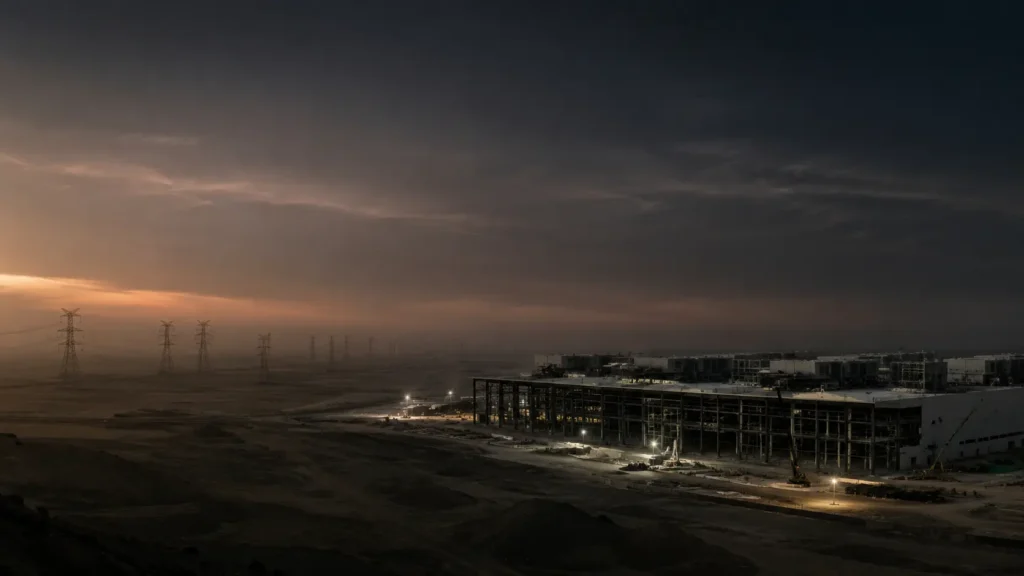
UAE AI infrastructure is being funded by sovereign capital, not by customers. The Abu Dhabi campus was commissioned before the demand that justifies it exists locally. That is the defining feature of this buildout, and it changes how founders and investors should read it.
Most coverage treats the numbers as evidence of ambition. The more useful question is narrower. Who carries the risk if the compute does not sell at the price the models assumed?
The scale problem, stated plainly
The UAE-US AI Campus in Abu Dhabi is designed for 5 gigawatts of capacity across 19.2 square kilometres. For comparison, the Barakah nuclear plant runs at 5.6 gigawatts and supplies roughly a quarter of all UAE electricity, according to the World Nuclear Association.
So UAE AI infrastructure at full build would need power approaching the output of the country’s largest single generating asset. That is not an incremental project. It is a second energy system, built for one customer class.
Within it sits Stargate UAE, a 1 gigawatt cluster developed by Khazna Data Centres, a G42 company. Mubadala’s Khaldoon Al Mubarak told the Milken Institute summit in December 2025 that the first 200 megawatts would be ready in the third quarter of 2026. That phase alone used more than 5,000 workers. It also consumed around 100,000 cubic metres of concrete.
Who is actually paying
Follow the ownership rather than the press releases.
G42 is backed by Mubadala. Khazna is a G42 subsidiary. MGX, the Abu Dhabi investment company chaired by Sheikh Tahnoun bin Zayed, counts Mubadala and G42 as partners. The equity underneath UAE AI infrastructure is therefore overwhelmingly sovereign, routed through entities that answer to the same ultimate owner.
The operating partners contribute something different. OpenAI and Oracle will run workloads. Nvidia supplies Grace Blackwell GB300 systems, roughly 100,000 chips for the first phase. Cisco provides networking, SoftBank capital. In other words, Abu Dhabi supplies the balance sheet and the power. Foreign firms supply the technology and the demand. That split defines the risk in UAE AI infrastructure.
The recycling pattern
This arrangement has a precedent. For fifty years the Gulf converted hydrocarbon surpluses into dollar assets, mostly US Treasuries and equities. The mechanism is now repeating with a different asset class.
In July 2026, a consortium of MGX, BlackRock’s Global Infrastructure Partners and the AI Infrastructure Partnership closed the acquisition of Aligned Data Centers. The enterprise value was about $40 billion, with a further $5 billion committed to expansion. Aligned holds 51 campuses and more than 6.4 gigawatts operational and planned, almost all in the United States.
Consequently much of this capital is not building UAE AI infrastructure at all. It is buying American digital infrastructure, in the same way petrodollars once bought American debt.
What the returns actually depend on
Three variables decide whether this works, and only one of them is under Abu Dhabi’s control.
Contract structure
Data centres behave like utilities when anchor tenants sign long take-or-pay leases. They behave like speculative property when they do not. A 200 megawatt hall with a fifteen-year OpenAI commitment is a bond. The same hall built on expected demand is a warehouse full of depreciating metal.
Depreciation mismatch
Here is the structural problem that infrastructure financing tends to obscure. The concrete lasts thirty years. The GB300 systems inside it have a useful economic life closer to three to five, because each Nvidia generation resets performance per dollar.
So the expensive half of the asset must be replaced roughly six times over the life of the shell. Therefore returns on UAE AI infrastructure depend less on the buildings than on whether compute pricing funds repeated re-equipping.
Power and heat
Wood Mackenzie estimated in March 2026 that UAE data centres consumed 3 terawatt hours in 2025, about 2 percent of national demand of 173 terawatt hours, rising above 6 terawatt hours by 2030. Those figures predate the campus reaching scale.
Cooling is the harder constraint. Gulf temperatures raise the energy penalty on every megawatt of compute. The energy build-out the UAE is running in parallel is partly a response to exactly this load.
The price that was not paid in cash
There is a second currency here. Deploying advanced Nvidia silicon in the Gulf required Washington to rescind Biden-era export restrictions, and the US Commerce Department established a bilateral security working group to oversee deployment.
That is a governance commitment, not a financial one. The UAE effectively exchanged a degree of technological sovereignty for chip access. For a country that has spent a decade positioning Abu Dhabi as the destination for serious institutional capital, that trade is coherent. It is still a dependency, and dependencies get repriced when administrations change.
The case that this is rational anyway
The sceptical read has an obvious answer, and it deserves stating fairly.
Sovereign wealth funds are not venture funds. Mubadala and MGX underwrite forty-year horizons, so a decade of thin returns is survivable if the position is strategic. Owning regional capacity means the UAE sets the terms on which MENA governments access frontier models. The alternative is renting them from Virginia or Dublin.
There is also a real physical advantage behind UAE AI infrastructure. The country hosts 19 international submarine cables and runs the only nuclear fleet in the region. It recorded 99.5 percent fibre-to-the-home coverage in 2024. Few jurisdictions offer low-carbon baseload plus latency to Europe, Asia and Africa from one site.
What founders should take from this
For most UAE companies, the practical consequence arrives in the third quarter of 2026, when local high-end inference capacity comes online.
That should compress latency and improve data-residency options for regulated sectors. It matters most for health, banking and government contracting. However, cheap compute is not guaranteed. Anchor tenants get the good pricing; everyone else buys at the margin.
Two disciplines follow. First, treat sovereign cloud availability as a compliance advantage rather than a cost saving, because that is where the durable benefit sits. Second, avoid building a company whose economics need compute prices to fall on a schedule nobody has promised. The gap between AI adoption and AI dependence is where most of the risk currently lives.
So who pays for UAE AI infrastructure
Abu Dhabi pays. The equity is sovereign, the power is domestic, and the downside sits with Mubadala and MGX rather than with OpenAI, Oracle or Nvidia, all of which are compensated whether or not the utilisation forecasts hold.
That allocation is deliberate. The UAE is buying a position in the compute layer of the next economy. It accepts infrastructure-style risk on an asset that depreciates like consumer electronics. If model demand keeps compounding, it will look prescient. If demand plateaus, the country will own a great deal of expensive, well-cooled capacity in the desert.
The honest answer is that nobody knows yet. What founders can know is that UAE AI infrastructure is a national wager, and wagers of this size reshape the environment they are placed in, whether or not they pay off.
Frequently Asked Questions
The campus is designed for 5 gigawatts of capacity across 19.2 square kilometres. Within it, Stargate UAE is a 1 gigawatt cluster built by Khazna Data Centres. Its first 200 megawatt phase was scheduled for completion in the third quarter of 2026.
Funding is predominantly sovereign. G42 is backed by Mubadala, Khazna is a G42 subsidiary, and MGX counts Mubadala and G42 as partners. Foreign firms including OpenAI, Oracle, Nvidia, Cisco and SoftBank contribute technology, operations and demand rather than the underlying capital.
AIP was established in September 2024 by BlackRock, Global Infrastructure Partners, MGX, Microsoft and Nvidia, later joined by xAI and the Kuwait Investment Authority. It targets $30 billion in equity and up to $100 billion including debt. BlackRock reported $12.5 billion raised on its Q4 2025 earnings call.
Wood Mackenzie estimated in March 2026 that UAE data centres consumed 3 terawatt hours during 2025, roughly 2 percent of national electricity demand of 173 terawatt hours. Consumption is projected to exceed 6 terawatt hours by 2030 as AI workloads scale.
Sources: OpenAI, Introducing Stargate UAE, May 2025; G42, Global Tech Alliance Launches Stargate UAE, May 2025; The National, Stargate UAE’s First Phase to Be Completed in Third Quarter of 2026, December 2025; Business Wire, AIP, MGX and BlackRock’s GIP Close Acquisition of Aligned Data Centers, July 2026; The National, BlackRock-MGX Consortium Commits $5bn for Aligned Data Centres, July 2026; BlackRock, AI Infrastructure Partnership Press Release, March 2025; Data Center Dynamics, BlackRock Raises $12.5bn for AI Partnership With Microsoft and MGX, June 2026; Wood Mackenzie, UAE Data Centre Energy Analysis, March 2026, cited in Data Center World Middle East; World Nuclear Association, Nuclear Power in the United Arab Emirates, 2026; Forbes, What Powers Microsoft’s $15 Billion Abu Dhabi Data Centers, December 2025.
Founders of UAE (FOUAE) is an independent, digital-first business publication covering the founders, companies and economy of the United Arab Emirates. Follow FOUAE on Instagram and LinkedIn.