- Do the new UAE e-invoicing penalties apply to my business?
- What are the new UAE e-invoicing penalties?
- What the AED 50,000 cap does not cover
- When do the new UAE e-invoicing penalties take effect?
- What is an Accredited Service Provider?
- Why the UAE eased e-invoicing penalties now
- The verdict on UAE e-invoicing penalties
- Frequently Asked Questions
- Sources
UAE e-invoicing penalties for failing to implement the system will be capped at AED 50,000 (Dh50,000) in any 12 consecutive months. The AED 5,000 monthly fine stays. Cabinet Decision No. 173 of 2026, the decision behind the Ministry of Finance’s 30 October announcement, replaces Decision 106 of 2025. It also removes system-failure fines.
Data: Cabinet Decision No. 173 of 2026 and Cabinet Decision No. 106 of 2025 (Ministry of Finance), Ministerial Decisions 244 of 2025, 66 of 2026 and 197 of 2026, UAE eInvoicing Guidelines V2.0, the Federal Tax Authority, Khaleej Times and Gulf News, September 2025 to October 2026. FOUAE calculations are marked. This explains the rules. It is not tax or legal advice.
In short
- Businesses with revenue of AED 50 million or more go live on 1 January 2027; smaller ones on 1 July 2027.
- Missing implementation costs AED 5,000, then AED 5,000 a month, capped at AED 50,000 in any 12 months.
- Fines for not reporting a system failure are gone.
- Decision 173 starts the day after it appears in the Official Gazette.
Do the new UAE e-invoicing penalties apply to my business?
The UAE e-invoicing penalties apply to businesses that must join the system under Ministerial Decision 244 of 2025, as amended by Ministerial Decision 66 of 2026. The trigger is gross revenue in the most recent accounting period, the decision states.
| Who | Appoint an ASP by | Go live by |
|---|---|---|
| Revenue of AED 50 million or more | 30 October 2026 | 1 January 2027 |
| Revenue under AED 50 million | 31 March 2027 | 1 July 2027 |
| Government entities | 31 March 2027 | 1 October 2027 |
Supplies to private individuals sit outside the system, the Ministry’s eInvoicing Guidelines say. Businesses that adopt e-invoicing voluntarily face no penalties for those invoices, the guidelines add. In addition, Ministerial Decision 197 of 2026 gives transactions between members of the same tax group a 24-month reprieve from 1 January 2027. The guidelines describe that as a grace period, not a removal from scope.
What are the new UAE e-invoicing penalties?
The new UAE e-invoicing penalties sit in Cabinet Decision No. 173 of 2026, published on the Ministry of Finance website. Article 4 repeals Decision 106 of 2025 in full.
| Violation | Old: Decision 106 of 2025 | New: Decision 173 of 2026 |
|---|---|---|
| Not implementing the system or appointing an ASP | AED 5,000 a month, no cap (issuers only) | AED 5,000, then AED 5,000 a month, capped at AED 50,000 in any 12 months (issuers and recipients) |
| Not issuing an e-invoice or credit note | AED 100 each, up to AED 5,000 a month | Unchanged |
| Not telling the FTA about a system failure | AED 1,000 a day, no cap | Removed |
| Not telling your ASP about changed FTA data | AED 1,000 a day, no cap | AED 250 a day, up to AED 5,000 a calendar month |
Decision 106, the old schedule, appeared in November 2025. The Ministry’s announcement did not mention the ASP-notice fine, and Gulf News said on 31 October that its treatment needed confirming from the legal text. The decision settles it at AED 250 a day, so that fine has fallen by 75 percent.
The FOUAE calculation
A year without implementing. Under Decision 106, 12 months of delay cost AED 60,000, with no ceiling. Under the new decision, the first-instance fine plus nine continuing months reaches AED 50,000, so the cap applies from roughly the 10th month. The decision does not say whether the first instance also counts as month one, so treat the timing as an illustration.
A calendar month without updating your ASP. Under the old rule, 30 days of delay cost AED 30,000. Under the new rule, 30 days at AED 250 comes to AED 7,500. However, a cap of AED 5,000 per calendar month limits a delay inside one month to AED 5,000. On FOUAE’s arithmetic, that is 83 percent less. If the 30 days straddle two calendar months, the total can reach AED 7,500, or 75 percent less.
What the AED 50,000 cap does not cover
The cap on UAE e-invoicing penalties is narrower than some headlines suggest, because it covers only the implementation failure. Fines for missing e-invoices and credit notes stay at AED 100 each, up to AED 5,000 a month, and each has its own monthly limit.
The cap also rolls rather than stops. It applies “within any period of (12) twelve consecutive months”, the decision states, so an open-ended failure can keep costing up to AED 50,000 a year. Meanwhile, the implementation fine now reaches recipients as well as issuers. As a result, a buyer that stops meeting its obligations faces the same fine.
If the same person is issuer, recipient or both for one violation, “only one administrative penalty” applies, the Ministry said.
When do the new UAE e-invoicing penalties take effect?
Decision 173 takes effect the day after it appears in the Official Gazette, Article 5 states. FOUAE could not find a Gazette publication date as of 31 October, and the Ministry’s announcement gave no effective date.
That leaves a timing question for large businesses, whose ASP deadline was 30 October. On 25 October, the Federal Tax Authority warned of a monthly fine for missing the ASP appointment. It said “AED 5,000 is imposed for each month or part thereof of delay”.
By contrast, the Ministry’s guidelines say penalties apply only from a business’s mandatory start date. For large firms, that is 1 January 2027. The line sits in a section on voluntary adoption. On FOUAE’s reading, the old UAE e-invoicing penalties under Decision 106, with an uncapped monthly fine, remain in force until Decision 173 appears in the Gazette. Either way, the FTA can confirm a business’s position.
What is an Accredited Service Provider?
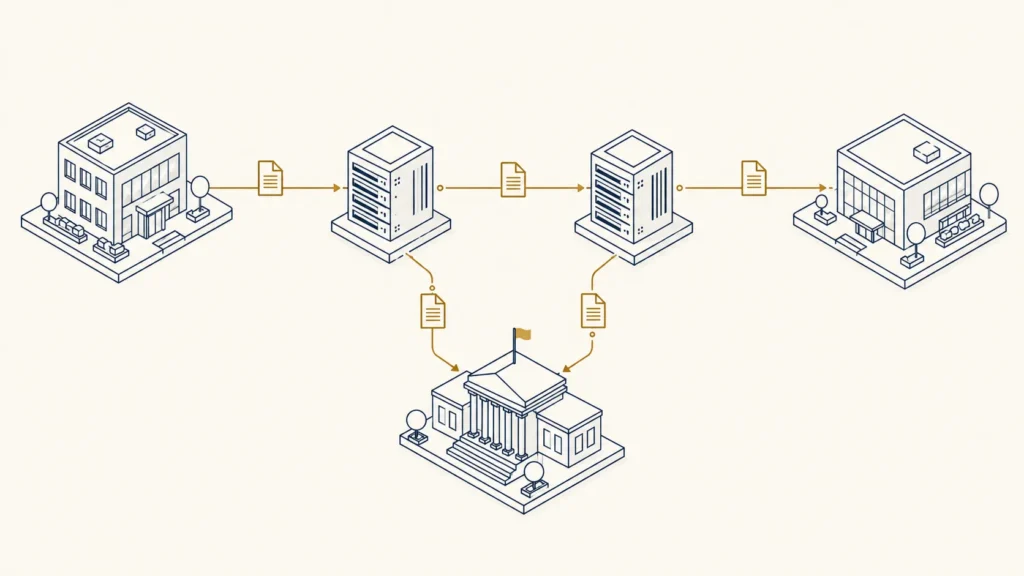
An Accredited Service Provider, or ASP, is a company the Ministry of Finance accredits to handle e-invoices. It sends your invoices to the buyer’s provider and reports the tax data to the FTA. Appointing one on time removes the main trigger for UAE e-invoicing penalties. The system follows a five-corner model on the Peppol network, the Ministry’s guidelines explain.
The Ministry’s list of accredited providers named 82 firms as of 30 October 2026. It includes software companies, accounting and advisory firms, and a DP World digital unit.
Why the UAE eased e-invoicing penalties now
The Ministry said it acted after stakeholder feedback, to make the framework “clear, proportionate and practical for businesses”. The change follows Ministerial Decision 197 of 2026, announced on 19 October. That decision dropped the duty to report system failures and removed the UAE-only data storage rule.
FOUAE’s reading, not a forecast: the government is lowering the cost of mistakes before mandatory go-live, while keeping the main monthly fine in place. On that reading, the incentive is to join on time, with fewer runaway fines for technical slips.
Under the old rules, advisers stressed the monthly cost of delay. “Every month of slippage has a price tag,” Anurag Chaturvedi, chief executive of Andersen UAE, told Khaleej Times in December 2025. Once Decision 173 takes effect, that cost will stop at AED 50,000 in any 12 months.
For smaller firms, the practical step stays the same. “Organisations should immediately focus on selecting an ASP,” Rohit Dayma, chairperson of the ICAI Abu Dhabi Chapter, told Khaleej Times in June. Our guides cover this month’s UAE e-invoicing rules and the UAE e-invoicing deadline for each group.
The verdict on UAE e-invoicing penalties
Under Cabinet Decision No. 173 of 2026, the new UAE e-invoicing penalties keep the AED 5,000 monthly fine for missing implementation. However, they cap it at AED 50,000 in any 12 months, remove system-failure fines and cut the ASP-notice fine by 75 percent. In practice, the deadlines are the bigger risk: 1 January 2027 for large firms, 1 July 2027 for smaller firms and 1 October 2027 for government entities.
Frequently Asked Questions
Cabinet Decision No. 173 of 2026 sets a fine of AED 5,000 for the first instance, then AED 5,000 for each month or part month of delay. The decision caps the total at AED 50,000 in any 12 consecutive months, once it takes effect.
Businesses with revenue of AED 50 million or more must go live by 1 January 2027. Smaller businesses must appoint an ASP by 31 March 2027 and go live by 1 July 2027, under Ministerial Decision 244 of 2025 as amended.
No. The Ministry of Finance said on 30 October 2026 that the new decision removes fines for not reporting a system failure to the FTA. Ministerial Decision 197 of 2026 had already removed the duty to report it.
Sources
Sources: Ministry of Finance, Cabinet Decision No. 173 of 2026 on e-invoicing violations and penalties, October 2026; Ministry of Finance, MoF announces updated administrative penalties, 30 October 2026; Cabinet Decision No. 106 of 2025, published November 2025; Ministerial Decision 244 of 2025 and Ministerial Decision No. 66 of 2026; Ministerial Decision 197 of 2026, 19 October 2026; UAE eInvoicing Guidelines V2.0, 26 October 2026; Ministry of Finance, list of accredited service providers, 30 October 2026; Federal Tax Authority deadline reminder, 25 October 2026; Gulf News, 31 October 2026; Khaleej Times, 7 December 2025 and 12 June 2026. The 12-month cost, cap timing and ASP-notice comparison are FOUAE calculations. This is general information, not tax or legal advice.
Founders of UAE (FOUAE) is an independent, digital-first business publication covering the founders, companies and economy of the United Arab Emirates. Follow FOUAE on Instagram and LinkedIn.