- What is the UAE Hormuz bypass?
- How much can Khor Fakkan really handle?
- Why the UAE Hormuz bypass needs more capacity
- Fujairah’s oil and fuel role
- How Etihad Rail links the bypass to the rest of the UAE
- Who gains from the UAE Hormuz bypass?
- The limits of a Hormuz bypass
- What the UAE Hormuz bypass means for founders
- The verdict on the UAE Hormuz bypass
- Frequently Asked Questions
- Sources
The UAE Hormuz bypass now handles container volume on a scale that bears comparison with Jebel Ali. Weekly volume at Khor Fakkan rose from about 8,000 to 65,000 TEU, The National reported on 7 July 2026. On FOUAE’s arithmetic, that pace equals about 22 percent of what Jebel Ali handled in 2024.
Data: The National, Khaleej Times, Enterprise, Semafor, AGBI and DP World, May to October 2026. FOUAE calculations are marked. TEU means twenty-foot equivalent unit, the standard size of a shipping container.
In short
- Khor Fakkan’s weekly volume grew about eight times after shipping through Hormuz fell sharply.
- Its owner plans to lift capacity from 3.5 million to 10 million TEU within three years.
- In oil, a second pipeline to Fujairah should double Adnoc’s export capacity there from 2027.
What is the UAE Hormuz bypass?
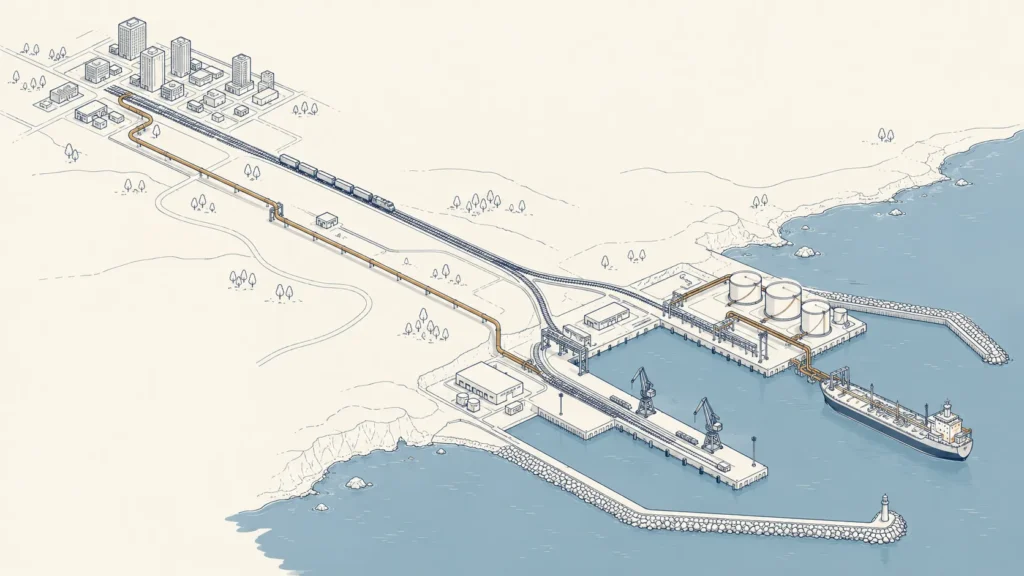
The UAE Hormuz bypass is a set of ports, pipelines and rail links on the Gulf of Oman coast. Together, they let goods and oil reach the UAE without using the Strait of Hormuz. The main parts are Khor Fakkan in Sharjah, Fujairah, the Habshan to Fujairah oil pipeline and Etihad Rail.
The idea is old. However, the war that began on 28 February 2026 turned a backup plan into a working system. Traffic through the strait has dropped sharply since then, The National reported on 15 October.
Abdulla bin Touq, the Minister of Economy and Tourism, framed it as a business case. “Redundancy means dollar signs. It means investments,” he said.
How much can Khor Fakkan really handle?
Khor Fakkan is the main container gate of the UAE Hormuz bypass, and it is filling up fast. Before the crisis, it moved about 8,000 TEU a week. By July, however, that figure had reached about 65,000 TEU, The National reported on 7 July.
The FOUAE calculation
First, the growth. 65,000 divided by 8,000 is about 8.1 times the old weekly volume.
Next, the yearly pace. At 65,000 TEU a week for 52 weeks, Khor Fakkan would move about 3.4 million TEU a year. That is above the 3 million TEU it had never exceeded before, AGBI reported in July 2026.
Finally, the comparison. Jebel Ali handled 15.5 million TEU in 2024, DP World reported. So Khor Fakkan’s current pace equals about 22 percent of Jebel Ali’s 2024 volume.
Still, a weekly peak may not last a full year. So treat this figure as a run rate.
Why the UAE Hormuz bypass needs more capacity
The bypass is close to its limits. In July, Khor Fakkan’s terminal had capacity for 3.5 million TEU a year, The National reported. As a result, a 3.4 million TEU pace left little spare room.
In response, Gulftainer, the port’s operator, set out a $2 billion plan across the port and its inland network in July:
- Within three months: capacity of 5 million TEU.
- Within 24 months: 7 million TEU.
- Within 36 months: 10 million TEU.
- Inland: two dry ports at Al Dhaid and Sajaa, with 2.3 million TEU of combined capacity.
At 10 million TEU, Khor Fakkan’s capacity would equal about 65 percent of Jebel Ali’s 2024 volume, on FOUAE’s arithmetic. Because that compares future capacity with past volume, treat it as a sense of scale.
Gulftainer chief executive Farid Belbouab presents the expansion as backup for larger hubs. “Our ambition is not to capture 100 per cent,” he said. “It’s really about giving that certainty.”
Fujairah’s oil and fuel role
Fujairah is the bypass’s oil and fuel hub. It has about 120 million barrels of storage, Robin Mills wrote in The National on 19 October.
Crude reaches Fujairah through the Habshan to Fujairah pipeline. That line can carry up to 1.8 million barrels a day, Khaleej Times reported in May 2026. In addition, Abu Dhabi Crown Prince Sheikh Khaled bin Mohamed bin Zayed directed Adnoc on 15 May to accelerate a new West-East pipeline. It should double Adnoc’s export capacity through Fujairah and start in 2027.
On FOUAE’s arithmetic, doubling 1.8 million implies total export capacity through Fujairah of roughly 3.6 million barrels a day. However, Adnoc has not published that figure.
For containers, by contrast, Fujairah is smaller. Its port can handle more than 720,000 TEU a year, according to AGBI.
How Etihad Rail links the bypass to the rest of the UAE
A port only helps if goods can leave it quickly. Abu Dhabi to Fujairah now takes under four hours by train, The National reported on 15 October.
Then, in September, Etihad Rail started moving containers about 200 kilometres from Fujairah to Abu Dhabi’s industrial city, three times a week, Semafor reported. As a result, the link ties Fujairah’s port more closely to Abu Dhabi’s industrial base. Steady freight links also matter for Dubai’s AED 2.1 trillion project pipeline.
Who gains from the UAE Hormuz bypass?
Free zone trade has held up despite the disruption. For example, Dubai Integrated Economic Zones handled a record Dh246 billion of trade in the first half of 2026, up 17 percent, Khaleej Times reported. Re-exports also rose 22 percent to about Dh108.8 billion.
On FOUAE’s reading, the likely gainers from the UAE Hormuz bypass are Sharjah’s ports, Fujairah’s fuel trade, and rail and trucking firms.
The hedge also reaches beyond the UAE. Fujairah is behind a $3 billion oil logistics buildout at El Hamra in Egypt, Enterprise reported on 19 October. “Egypt offers a logistics position that is not dependent on a single strait,” supply chain analyst Wolfgang Lehmacher told Enterprise.
The limits of a Hormuz bypass
Still, the bypass has limits. First, Jebel Ali is far bigger, so the east coast cannot replace it box for box today. Second, the wider economy still feels the strain. Dubai’s transport and storage output fell 7.4 percent in the first half of 2026, Khaleej Times reported on 19 October. Our look at Dubai’s GDP explains the wider picture.
Third, spare capacity costs money if traffic returns to Hormuz. Even so, Bin Touq was clear about the main route. “Hormuz really matters and it will keep on mattering,” he said.
What the UAE Hormuz bypass means for founders
The lesson is about supply chains. A firm that imports through one port now has a tested second route. Therefore, founders can assess the east coast for warehousing, cold storage and light manufacturing, which the new dry ports plan to offer.
The verdict on the UAE Hormuz bypass
So how much trade can the east coast carry? Today, Khor Fakkan’s annualised July pace equals about a fifth of Jebel Ali’s 2024 volume, on FOUAE’s arithmetic. Fujairah adds oil, fuel and storage. If Gulftainer’s plan holds, Khor Fakkan’s capacity by mid-2029 would equal nearly two thirds of that volume. In short, the UAE Hormuz bypass works as a second route alongside Jebel Ali, backed by new investment in ports, pipelines and rail.
Frequently Asked Questions
Partly. Khor Fakkan and Fujairah sit outside the strait, on the Gulf of Oman. Khor Fakkan’s weekly volume reached about 65,000 TEU in July 2026. The Habshan to Fujairah pipeline can also export up to 1.8 million barrels of crude a day.
Its terminal had capacity for 3.5 million TEU a year in July 2026. Gulftainer plans to reach 10 million TEU within 36 months, backed by $2 billion of investment.
Adnoc is building a West-East pipeline that should double its crude export capacity through Fujairah. Abu Dhabi’s Crown Prince told Adnoc to speed it up in May 2026, and it should start operating in 2027.
Sources
Sources: The National, Hormuz matters but UAE has more than one gateway, 15 October 2026; The National, Khor Fakkan port terminal capacity to be doubled, 7 July 2026; DP World, highest cargo volumes at Jebel Ali since 2015, February 2025; The National, Robin Mills on Gulf energy security, 19 October 2026; Khaleej Times, Adnoc to accelerate new pipeline project, May 2026; Khaleej Times, DIEZ trade jumps 17% to record Dh246 billion, 18 October 2026; Khaleej Times, Dubai’s GDP reaches Dh473 billion in first half of 2026, 19 October 2026; Enterprise, the UAE’s investment in Egypt as a Hormuz hedge, 19 October 2026; Semafor, new freight rail service connecting Fujairah with Abu Dhabi, 24 September 2026; AGBI, zero Hormuz shipping routes, July 2026. The growth multiple, run rate, shares of Jebel Ali’s volume and implied pipeline capacity are FOUAE calculations.
Founders of UAE (FOUAE) is an independent, digital-first business publication covering the founders, companies and economy of the United Arab Emirates. Follow FOUAE on Instagram and LinkedIn.