The best moment to buy Dubai property is rarely the price bottom. It is the fear peak, when the gap between what sellers accept and what buyers offer is widest. Dubai reached that point in March 2026, five weeks into the regional conflict, and the gap closed within days of the ceasefire.
That distinction matters because bottoms are only visible in hindsight. Fear peaks, by contrast, are measurable while they are happening. They show up in transaction volume, in viewing activity, and in the spread between asking and offer prices. Anyone deciding whether to buy Dubai property in 2026 therefore needs a framework rather than a forecast. The March standstill supplies one, because it has now played out fully, from panic to recovery.
Why the fear peak beats the price bottom
Conventional advice says to buy at the bottom. The advice is correct and useless, because nobody rings a bell.
What you can observe in real time is different. Sentiment turns most negative, volumes thin out, and buyers and sellers stop agreeing on what an asset is worth. Prices may still drift lower afterwards. However, the rate of decline slows, and the balance of motivation starts shifting.
March 2026 showed this clearly. Sellers held firm because nothing structural had changed on 28 February. They had bought into an undersupplied market with strong population growth. Buyers pushed for steep discounts because headlines were more vivid than supply data. Both sides were reading different inputs, not the same input differently.
The practical test is simple. Track how far apart asking prices and accepted offers sit in the community where you intend to buy Dubai property. When that spread widens while fundamentals hold, motivation is shifting toward the buyer. When it narrows again, the window is closing.
What the March 2026 standstill actually looked like
The numbers were less dramatic than the commentary. ValuStrat’s price index fell 5.9 percent in March 2026, its first monthly drop since 2020. That erased roughly six months of gains and returned values to September 2025 levels. Annual growth still ran at positive 8.9 percent.
Dubai’s listed property stocks took the harder hit. The DFM Real Estate Index dropped about 20 percent across five sessions in late February and early March 2026.
Yet transaction data told a third story. Dubai Land Department figures for the first quarter of 2026 showed 48,445 cross-border deals, up 11 percent year on year, with foreign transaction value rising roughly 26 percent. Foreign capital never actually left.
How fast the gap closed
Donald Trump announced a two-week ceasefire on the evening of 7 April 2026. The response was immediate.
Allsopp and Allsopp’s internal brokerage data recorded viewing activity up 198 percent week on week, buyer enquiries up 147 percent, and completed transactions up 98 percent. Mortgage submissions moved fastest of all, with more applications filed in the first eight days of April than in all of March. These are one firm’s numbers rather than market-wide statistics, so treat them as directional. The direction, though, was unambiguous.
The supply gap that made the window real
A fear peak is only an opportunity if fundamentals survive the scare. Here they did.
Dubai added more than 200,000 residents during 2025, according to Engel and Voelkers’ mid-year review published in July 2026. Residential handovers that year reached roughly 42,000 units, up from about 29,000 in 2024. Demand from population growth alone therefore ran ahead of completions.
Why launch numbers overstate supply
Developers announce far more than they deliver. Fitch Ratings found that between 2022 and 2024, about 97,000 of 174,000 scheduled units were actually completed, a 56 percent rate. Morgan’s International Realty projected that only 48 percent of the 71,613 units forecast for 2026 would be handed over, or roughly 34,740 homes.
The causes are structural: contractor shortages, financing delays, and inconsistent buyer payment schedules. Consequently headline pipeline figures should be discounted heavily. Anyone planning to buy Dubai property needs the delivery number, not the launch number.
How to buy Dubai property by segment
Discipline here is not about speed. The decision to buy Dubai property is really three decisions, and each carries a different risk. Match the asset to the holding period.
Prime and waterfront
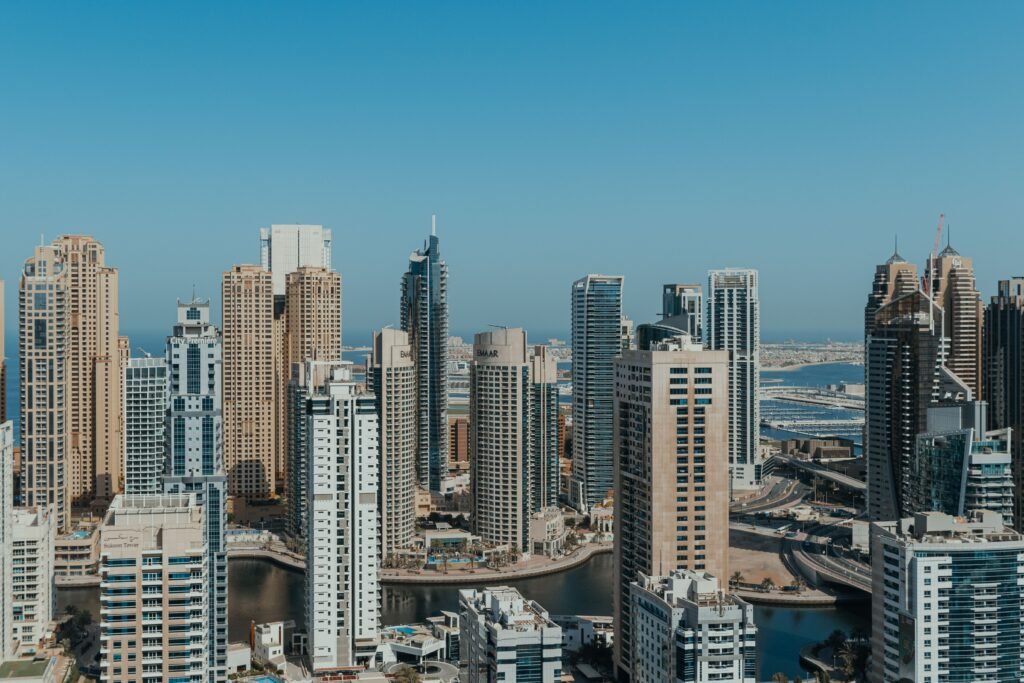
Palm Jumeirah, Dubai Marina, Jumeirah Bay Island and Downtown Dubai held value best through the conflict. Limited supply, cash-dominated buyers and wealth-preservation demand explain why. Knight Frank estimated cash sales at 86 percent of Dubai transaction volume across the first three quarters of 2025, which insulates these areas from rate moves.
Off-plan
The low-volume weeks produced payment flexibility that had vanished during 2025. Developers who had demanded large upfront deposits stretched their plans out. Those terms are temporary, because competition removes them. A 2028 handover bought on war-era terms is a purchase into two more years of population growth. Developers such as Mirwais Azizi at Azizi and Rahail Aslam at Select Group are among those whose completion records are worth checking before committing.
Financing and holding costs
Leverage changes the arithmetic. Because the dirham is pegged to the dollar, UAE mortgage rates track Federal Reserve policy rather than local demand. Buyers who intend to buy Dubai property with debt should therefore model the rate path alongside the purchase price. Cash buyers carry no such exposure, which partly explains prime resilience.
Secondary apartments
Here the calculation inverts. Jumeirah Village Circle alone has 16,852 units scheduled across 2025 to 2027, per Morgan’s International Realty. Even at historical completion rates, that volume pressures pricing. Buyers in these communities need a 2027 absorption thesis, not a sentiment-recovery thesis.
What would invalidate this thesis
Discipline means naming what breaks the argument.
The ceasefire was a two-week truce, not a settlement. Renewed conflict would reset sentiment, hit tourism and aviation again, and push recovery into 2027. Leveraged buyers on short timelines carry that risk; cash buyers largely do not.
Then there is 2027 itself. Morgan’s projects 70,537 completions that year, close to double the five-year average of 35,531 units. Even partial delivery would represent the heaviest supply Dubai has absorbed in over a decade. That pressure is independent of geopolitics, and it lands hardest on the same secondary apartment stock where discounts look most tempting today. Investors who buy Dubai property in those communities should model a slower exit.
What March 2026 teaches about when to buy Dubai property
The window has closed. Volumes recovered, conversions rose, and the fear peak passed months ago. Reading this now, you have missed that particular entry point.
The transferable lesson is the mechanism. Watch the spread between asking and offer prices, not the headlines. Check whether the structural case has genuinely changed or only the mood. In March 2026 the fundamentals were untouched: population up, deliveries running below forecast, foreign capital still arriving.
Dubai will produce another standstill. When it does, the buyers who look right afterwards will be those who finished their analysis while everyone else was still forwarding crash predictions. The all-clear always arrives after the optimal entry point.
Frequently Asked Questions
The sharpest discount window closed after the April 2026 ceasefire. Fundamentals remain supportive: Dubai added over 200,000 residents in 2025, and completions ran near 42,000 units. However, the 2027 supply wave means segment selection now matters more than timing.
ValuStrat’s index fell 5.9 percent in March 2026, the first monthly decline since 2020. That returned values to roughly September 2025 levels, erasing about six months of gains. Annual price growth remained positive at 8.9 percent through the period.
Morgan’s International Realty projects 70,537 residential completions in Dubai during 2027, nearly double the five-year average of 35,531 units. Delayed handovers from 2025 and 2026 are stacking into that year, concentrating pressure on high-density apartment communities.
Prime and waterfront districts proved most resilient, including Palm Jumeirah, Dubai Marina, Jumeirah Bay Island and Downtown Dubai. Limited supply and cash-dominated buyers explain the resilience. Knight Frank put cash sales at 86 percent of Dubai transaction volume in the first three quarters of 2025.
Sources: ValuStrat, Dubai Price Index March 2026, April 2026; Dubai Land Department, Q1 2026 Transaction Data, April 2026; Allsopp and Allsopp, Internal Brokerage Data April 2026, cited in Gulf Daily News, June 2026; Engel and Voelkers, Dubai Housing Market Mid-Year Review, July 2026; Morgan’s International Realty, Dubai Residential Supply and Delivery Outlook 2025 to 2027; Fitch Ratings, Dubai Residential Completion Rates 2022 to 2024, cited in Morgan’s International Realty; Knight Frank, Dubai Cash Transaction Share 2025, cited in Global Property Guide, June 2026; Cavendish Maxwell, Dubai Residential Market Performance Q3 2025, November 2025; Arabian Business, Inside Dubai’s More Focused Property Market Recovery, April 2026; Business Today, Dubai Property Paused on War Fears, April 2026.
Founders of UAE (FOUAE) is an independent, digital-first business publication covering the founders, companies and economy of the United Arab Emirates. Follow FOUAE on Instagram and LinkedIn.