- Where the Strait of Hormuz closure stands today
- Why insurance is the real chokepoint
- What the Strait of Hormuz closure costs UAE business
- The Strait of Hormuz closure effect that outlasts the war
- What founders should do about the Strait of Hormuz closure
- The honest outlook
- Frequently Asked Questions
- Sources
The Strait of Hormuz closure did not end in April. It is running now, in August 2026, and the binding constraint has shifted from missiles to underwriters. War-risk premiums have moved from 0.25 percent of hull value to between 3 and 10 percent, which prices most voyages out of existence regardless of what any ceasefire announcement says.
That distinction matters because the story left the front pages while the cost stayed in the accounts.
Where the Strait of Hormuz closure stands today
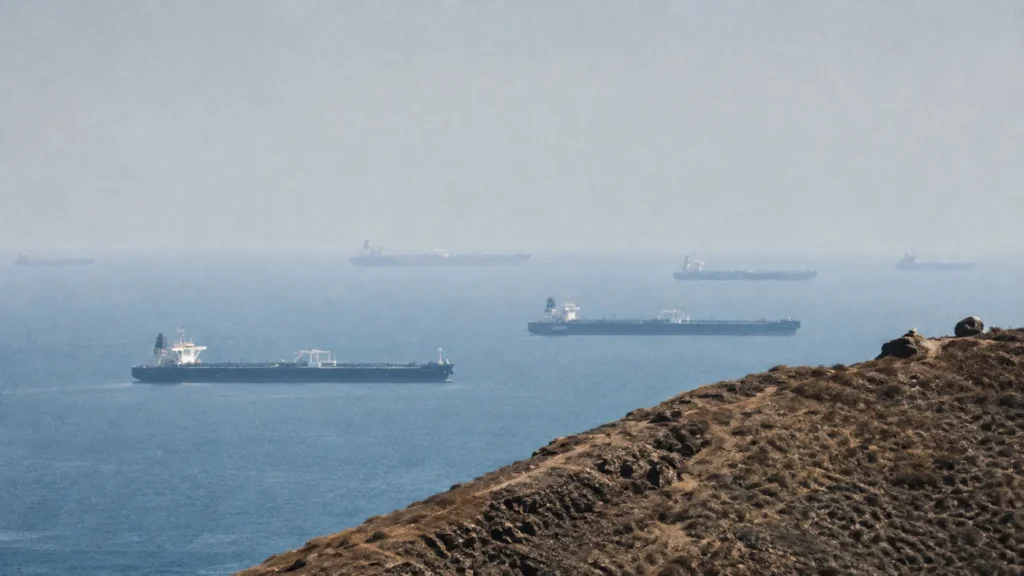
IMF PortWatch recorded a single transit on 9 August 2026, against a pre-crisis baseline near 73 vessels a day. Roughly 449 vessels were holding position away from berth in mid-August, and Brent traded around $88 a barrel on 17 August.
Convoys move under naval escort. Some tankers transit with tracking switched off, so real flow may exceed the visible figure. Neither detail changes the direction of the Strait of Hormuz closure.
How the reopening failed
The sequence is worth setting out, because it explains why announcements no longer move ships.
Iran closed the waterway to normal commercial traffic within 48 hours of the strikes on 28 February 2026. A ceasefire followed in April. On 17 June the United States and Iran signed a memorandum reopening the strait toll-free. Traffic stayed well below normal even then.
That arrangement broke down in early July after fresh attacks on commercial vessels. In mid-July, Iranian cruise missiles struck two UAE supertankers, the Mombasa and the Al Bahyah, both operated by ADNOC Logistics and Services. One sailor was killed and eight were injured. On 15 August, the UAE accused Iran of striking another oil tanker.
Why insurance is the real chokepoint
Here is the mechanism most coverage misses during a Strait of Hormuz closure. Politics decides whether passage is legal. Insurance decides whether it happens.
A $100 million tanker faced war-risk premiums near $250,000 before the conflict. It now faces between $3 million and $10 million for the same hull, according to figures reported by The National in July 2026. Several protection and indemnity clubs have withdrawn cover entirely.
What that does to a voyage
No underwriter, no transit. Charterers will not sail uninsured cargo, and owners cannot risk a total loss without cover.
So a reopening declaration is necessary but nowhere near sufficient. Naval forces must certify corridors. Insurers must then reinstate terms, and both steps take weeks rather than days. Consequently the strait can be legally open and commercially shut at the same time, which is roughly the position through much of the summer.
What the Strait of Hormuz closure costs UAE business
The direct exposure is enormous, and Dubai carries more of it than the headlines suggest.
Around a fifth of the world’s oil and gas normally moves through this waterway, and the UAE sits on the wrong side of it for trade purposes. Every landed cost in the emirate now carries a war-risk component that did not exist in January.
Jafza and Jebel Ali Port together account for around 36 percent of Dubai’s GDP, per Dubai Media Office figures, with more than 11,000 companies in the free zone alone. Every one of those firms assumed open passage. The stress points this exposed are now operating conditions rather than scenarios.
The second corridor problem
Worse, the alternative route was blocked at the same time. Houthi attacks resumed on Red Sea shipping, which had already been running near half of pre-crisis capacity.
That simultaneity is what turned a chokepoint problem into a regional one. A single closure invites rerouting, whereas two closures leave only cost.
For a period this year, both major maritime routes serving the region were simultaneously constrained. Maersk, MSC, CMA CGM and Hapag-Lloyd all suspended Hormuz transits. Companies that had built a second route found their second route was the first route’s twin.
The Strait of Hormuz closure effect that outlasts the war
Howden Re’s March 2026 analysis called this the worst oil supply shock in nearly 50 years and a rare multi-line insurance event, hitting marine, energy, aviation and political risk simultaneously.
Its more consequential judgement concerns pricing. Red Sea disruption across 2024 and 2025, followed by the Strait of Hormuz closure in 2026, amounts to permanent structural repricing of marine war risk. A new baseline, not a spike.
Why a new baseline matters more than a peak
Spikes get absorbed. Baselines get built into every quote, every landed cost and every margin calculation for years, which is why the Strait of Hormuz closure will outlive its own headlines.
Therefore the durable economic effect is not the months of blockade. It is that shipping through this region now costs more permanently. That compresses the arbitrage which made the UAE re-export model work. Thin-margin trading businesses feel this first and hardest.
What founders should do about the Strait of Hormuz closure
Three practical responses follow, and none requires predicting the politics.
Reprice contracts, do not absorb. Fixed-price supply agreements signed before February are now loss-making for many importers. Renegotiate with a freight and insurance adjustment clause rather than eating the difference quietly.
Audit your true routing exposure. Fujairah, Khor Fakkan and the Etihad Rail corridor sit outside the chokepoint, which is why firms with those relationships moved in week one while others waited. The companies that held through the disruption had already built that optionality.
Extend your cash runway assumption. Longer transit times mean working capital tied up in inventory afloat. A business modelling 30-day cycles against 60-day realities runs out of room before it runs out of demand.
Check what your insurance actually excludes. Many cargo policies carry war and strikes exclusions that were dormant for decades. Read the wording now rather than after a claim, because several protection and indemnity clubs have already withdrawn cover for this passage.
The honest outlook
Nobody can forecast the reopening date, and anyone offering one is guessing.
The structure, though, is clear enough. Around 6,000 seafarers remain trapped in the region, with the International Maritime Organisation working on evacuation. Traffic sits at a fraction of normal. Premiums remain at multiples of pre-war levels, and no durable arrangement has replaced the June memorandum.
The Strait of Hormuz closure is now the most important economic variable in this region, and also the least discussed. It no longer produces new images, so it no longer produces coverage. Businesses planning on the assumption that the war ended in April are planning against a version of events that stopped being accurate in July.
Frequently Asked Questions
Effectively no. IMF PortWatch recorded one transit on 9 August 2026 against a pre-crisis baseline near 73 vessels a day. Convoys move under naval escort, but routine commercial shipping has not resumed.
War-risk premiums have moved from around 0.25 percent of hull value before the conflict to between 3 and 10 percent. A $100 million tanker now faces $3 million to $10 million per policy, against roughly $250,000 previously.
The United States and Iran signed a memorandum on 17 June reopening the strait toll-free, but traffic stayed low while insurers waited. The arrangement collapsed in early July after renewed attacks on commercial vessels, including two UAE supertankers.
Jafza and Jebel Ali Port generate roughly 36 percent of Dubai’s GDP, and more than 11,000 free zone companies depend on passage. Higher freight and insurance costs compress margins across the re-export and trading sectors.
Sources
Sources: IMF PortWatch, Strait of Hormuz transit data, August 2026; The National, Shipping Insurance Surges Again as Attacks Intensify Over Strait of Hormuz, July 2026; Al Jazeera, Strait of Hormuz Reopens: But Can Ships’ Safety Be Assured, June 2026; CNBC, Strait of Hormuz Reopening May Take Weeks to Ease Shipping Backlog, June 2026; Howden Re, Strait of Hormuz Report, March 2026; Dubai Media Office, Jafza Contribution to Dubai’s Economy, May 2025; S&P Global Commodity Insights, Middle East Conflict Raises Shipping Risks, 2026; Khaleej Times, ADNOC Vessel Attacks and Strait Reopening Calls, August 2026.
Founders of UAE (FOUAE) is an independent, digital-first business publication covering the founders, companies and economy of the United Arab Emirates. Follow FOUAE on Instagram and LinkedIn.