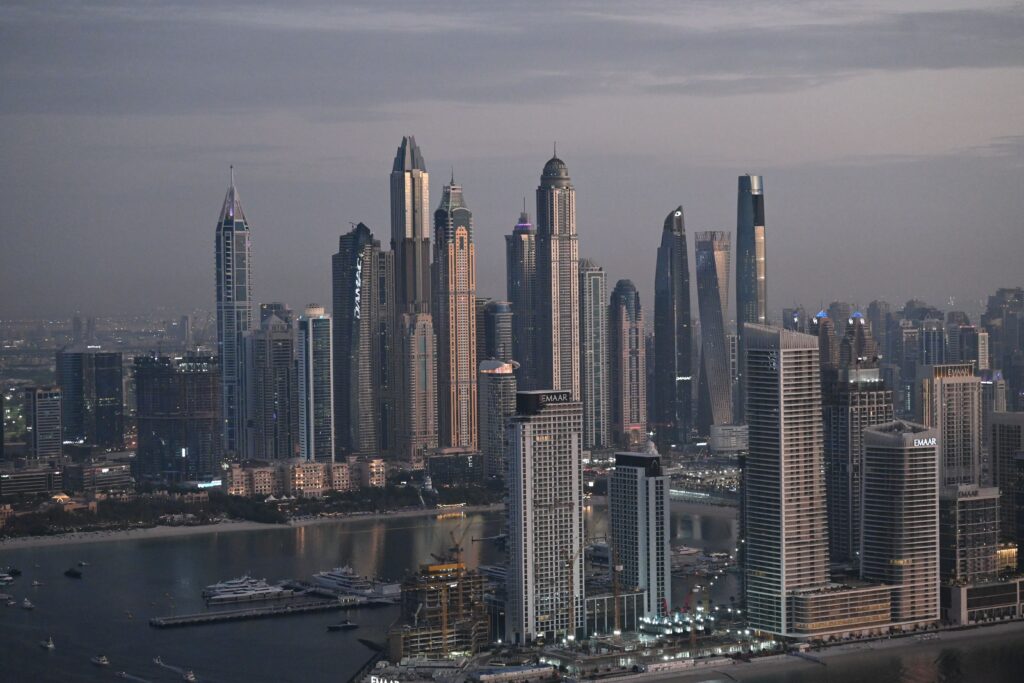
The gap between what social media claims happened to Dubai property and what the transaction data actually shows is not minor. It is the difference between a panic and an opportunity.
The messages circulating in WhatsApp investment groups throughout March 2026 had a consistent claim: Dubai property had crashed 30 to 40 percent. Screenshots of red stock charts circulated alongside satellite images of smoke plumes over the city. The conclusion drawn by thousands of investors was simple and alarming. The Dubai boom was over.
The data tells a different story.
According to verified transaction data from the Dubai Land Department, actual property prices fell between 4 and 7 percent from their pre-conflict peak. Meanwhile, Goldman Sachs data confirmed that Emaar Properties shares fell nearly 40 percent from pre-conflict levels. Both numbers are real. They measure completely different things. Confusing them is the most expensive mistake a Dubai property investor can make right now.
Two Markets, One Misunderstanding
The Dubai Financial Market Real Estate Index (DFMREI) tracks the share prices of publicly listed property developers, companies like Emaar, Aldar, and DAMAC that trade on the stock exchange. When the US-Israel strikes on Iran began on February 28, 2026, this index collapsed from approximately 16,700 points to 13,353 by March 9, a drop of 21 percent in under two weeks.
That collapse is exactly what stock markets do during geopolitical shocks. Listed equities react within seconds to headline risk because they are priced continuously by traders and algorithms weighing sentiment, expected future cash flows, and risk premiums. The index does not measure what a two-bedroom apartment in Dubai Marina is worth today. It measures how fearful equity investors are about developer earnings over the next twelve months.
Physical property is an entirely different market. Prices do not update in real time. They are established through individual transactions between a willing buyer and a motivated seller, involving site visits, financing negotiations, and legal processes that typically take weeks. A geopolitical shock compresses transaction volume first, and price second, and the price compression is structurally limited by the dynamics of undersupply.
The Middle East Insider, drawing on verified transaction data, summarised the position clearly: the gap between the DFMREI performance of negative 21 percent and actual property prices of negative 5 to 8 percent reflects exaggerated institutional fear more than fundamental deterioration. The crash that circulates on social media is a stock market story being read as a real estate story. They are not the same.
What the DLD Data Actually Shows
If Dubai property had genuinely crashed, the Dubai Land Department transaction data would confirm it. It does not.
January 2026 recorded AED 72.4 billion in residential real estate sales, the single highest monthly transaction total in Dubai’s history. This figure was logged before the conflict began, and it reflects a market that entered 2026 at record strength. Across the full first quarter, total residential sales reached AED 176.7 billion, a 23.4 percent year-on-year increase despite the conflict commencing mid-quarter.
The conflict did slow transaction volume in March. Completed sales fell 11.4 percent compared to March 2025, and 21 percent compared to February 2026. But volume slowdown and price collapse are distinct phenomena. When international buyers cannot fly in for site visits because airspace is disrupted, transactions pause. Prices do not automatically fall 30 percent to compensate for the inability to travel.
The most instructive data point is the composition of sales during the conflict itself. Off-plan purchases, where buyers commit to a property that will be delivered in 2027 or 2028, accounted for 69 to 77 percent of all transaction value throughout the hostilities. Buyers were not fleeing. They were signing contracts for future delivery of Dubai property during active missile interceptions. That is structural confidence, not panic behaviour.
What a Real Crash Looks Like
Comparisons to the 2008 to 2009 global financial crisis are instructive precisely because that episode was a genuine Dubai property crash, and the contrast with today is significant.
Between late 2008 and 2010, Dubai property values fell more than 50 percent from peak. The correction lasted 18 months, deepened through 2009, and was driven by factors that are absent today: developer insolvency, a legal framework that did not protect off-plan buyers, massive speculative overleveraging, an actual oversupply of units across all segments, and the collapse of mortgage financing.
None of those conditions exist in 2026. The undersupply that defined the Dubai property market entering this year remains intact. Dubai completed approximately 22,400 new residential units in 2025 against an estimated demand of more than 34,000 units from population growth and inward migration. A geopolitical shock pauses demand. It does not eliminate the underlying demographic and economic forces that were driving that demand before February 28.
CBRE’s Anshuman Magazine stated the position clearly: “Dubai’s real estate fundamentals remain resilient,” adding that “Dubai’s regulatory framework and robust infrastructure continue to attract international capital.” Knight Frank projected a 3 percent price rise in prime Dubai for 2026 before the ceasefire was even announced. Post-ceasefire recovery momentum is expected to push that trajectory higher.
The Psychology Behind the Crash Narrative
Understanding why the crash narrative took hold despite contradicting the evidence requires a brief examination of investor psychology.
Availability bias causes people to weight recent dramatic events disproportionately. Images of smoke over Dubai, headlines about market closures, and satellite imagery of port damage created an emotional reality that felt like economic collapse. Social media and WhatsApp groups amplified the most alarming data points, the stock index decline and the hotel occupancy collapse, without providing the context that distinguishes equity markets from property markets.
The result was a mass inference error: the stock market fell sharply, therefore property has crashed. This reasoning would fail a first-year finance exam, but it drove genuine investor behaviour, pausing site visits, freezing transactions, and generating the volume slowdown that itself became evidence cited in the crash narrative.
The market’s own recovery has since corrected the record. When the US-Iran ceasefire was announced on April 8, 2026, property viewings surged 198 percent week-over-week. Buyer inquiries jumped 147 percent. Completed sales rose 98 percent. Allsopp and Allsopp’s internal brokerage data confirmed this pattern across its active portfolio. The pent-up demand that had been frozen by conflict uncertainty was not gone. It was waiting.
The Strategic Implication
A 4 to 7 percent price correction from a historic peak, in a market with a structural undersupply of more than 11,000 units per year, at a moment of maximum fear and minimum competition among buyers, is not a crash. It is an entry point dressed up as a catastrophe.
The investors who understand the distinction between a stock index and a physical asset price, who recognise that transaction volume decline and price collapse are different phenomena, and who can separate the emotional impact of conflict from the structural reality of the market, are precisely the investors who will look most correct in retrospect.
Dubai’s fundamentals did not change on February 28, 2026. The tax environment, the ownership laws, the visa architecture, the undersupply, and the demand profile were all intact when the war began. They remain intact now that the ceasefire holds.
The crash exists on WhatsApp. The market exists in the data.
Sources: Dubai Land Department Q1 2026 Transaction Data; Goldman Sachs Dubai Real Estate Analysis March 2026; CBRE UAE Real Estate Report Q1 2026; Knight Frank Prime Dubai Report 2026; The Middle East Insider DFM Real Estate Index Analysis; Allsopp and Allsopp Internal Brokerage Data; Sherwood’s Property Dubai Market Analysis April 2026; DFM Index Historical Data.